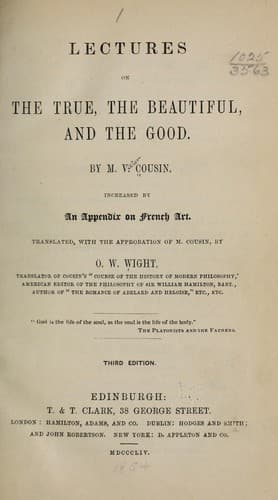
Lectures on the true, the beautiful and the goodCousin, Victor
Philosophy
Lectures on the true, the beautiful and the good
Cousin, Victor
Aesthetics; Ethics; Truth
But all doubt disappears before the following passages from the
_Phaedrus_, neglected, as it would seem designedly, by the detractors of
Plato: "In this transition, (the soul) contemplates justice,
contemplates wisdom, contemplates science, not that wherein enters
change, nor that which shows itself different in the different objects
which we are pleased to call beings, but science as it exists in that
which is called being, _par excellence_...."[51]--"It belongs to the
soul to conceive the universal, that is to say, that which, in the
diversity of sensations, can be comprehended under a rational unity.
This is the remembrance of what the soul has seen during its journey _in
the train of Deity_, when, disdaining what we improperly call beings, it
looked upwards to the only true being. So it is just that the thought of
the philosopher should alone have wings; for its remembrance is always
as much as possible with _the things which make God a true God, inasmuch
as he is with them_."[52]
So the objects of the philosopher's contemplation, that is to say,
Ideas, are in God, and it is by these, by his essential union with
these, that God is the true God, the God who, as Plato admirably says in
the _Sophist_, participates in _august and holy intelligence_.[53]
It is therefore certain, that, in the true Platonic theory, Ideas are
not beings in the vulgar sense of the word, beings which would be
neither in the mind of man, nor in nature, nor in God, and would subsist
only by themselves. No, Plato considers Ideas as being at once the
principles of sensible things, of which they are the laws, and the
principles also of human knowledge, which owes to them its light, its
rule, and its end, and the essential attributes of God, that is to say,
God himself.
Plato is truly the father of the doctrine which we have explained, and
the great philosophers who have attached themselves to his school have
always professed this same doctrine.
The founder of Christian metaphysics, St. Augustine, is a declared
disciple of Plato: everywhere he speaks, like Plato, of the relation of
human reason to the divine reason, and of truth to God. In the _City of
God_, book x., chap. ii., and in chap. ix. of book vii. of the
_Confessions_, he goes to the extent of comparing the Platonic doctrine
with that of St. John.
He adopts, without reserve, the theory of Ideas. _Book of Eighty-three
Questions_, question 46: "Ideas are the primordial forms, and, as it
were, the immutable reasons of things; they are not created, they are
eternal, and always the same: they are contained in the divine
intelligence; and without being subject to birth and death, they are the
types according to which is formed every thing that is born and
dies."[54]
Public-domain text, read in full here on John Shaqi.
Reviews
Reviews
No reviews yet
Be the first to share your thoughts on this work.
Join the Discussion
Join the discussion
Sign in to leave a comment or review.
Sign InorCreate an account