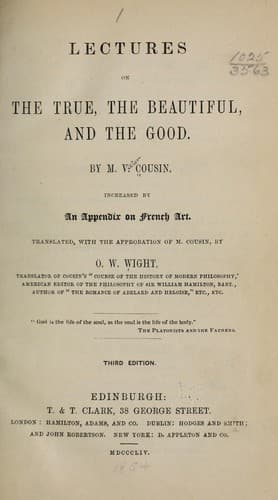
Lectures on the true, the beautiful and the goodCousin, Victor
Philosophy
Lectures on the true, the beautiful and the good
Cousin, Victor
Aesthetics; Ethics; Truth
"What man, pious, and penetrated with true religion, would dare to deny
that all things that exist, that is to say, all things that, each of its
kind, possess a determinate nature, have been created by God? This point
being once conceded, can it be said that God has created things without
reason? If it is impossible to say or think this, it follows that all
things have been created with reason. But the reason of the existence
of a man cannot be the same as the reason of the existence of a horse;
that is absurd; each thing has therefore been created by virtue of a
reason that is peculiar to it. Now, where can these reasons be, except
in the mind of the Creator? For he saw nothing out of himself, which he
could use as a model for creating what he created: such an opinion would
be sacrilege.[55]
"If the reasons of things to be created and things created are contained
in the divine intelligence, and if there is nothing in the divine
intelligence but the eternal and immutable, the reasons of things which
Plato calls Ideas, are the eternal and immutable truths, by the
participation in which every thing that is is such as it is."[56]
St. Thomas himself, who scarcely knew Plato, and who was often enough
held by Aristotle in a kind of empiricism, carried away by Christianity
and St. Augustine, let the sentiment escape him, "that our natural
reason is a sort of participation in the divine reason, that to this we
owe our knowledge and our judgments, that this is the reason why it is
said, that we see every thing in God."[57] There are in St. Thomas many
other similar passages, of perhaps an expressive Platonism, which is not
the Platonism of Plato, but of the Alexandrians.
The Cartesian philosophy, in spite of its profound originality, and its
wholly French character, is full of the Platonic spirit. Descartes has
no thought of Plato, whom apparently he has never read; in nothing does
he imitate or resemble him: nevertheless, from the first, he is met in
the same regions with Plato, whither he goes by a different route.
Public-domain text, read in full here on John Shaqi.
Reviews
Reviews
No reviews yet
Be the first to share your thoughts on this work.
Join the Discussion
Join the discussion
Sign in to leave a comment or review.
Sign InorCreate an account