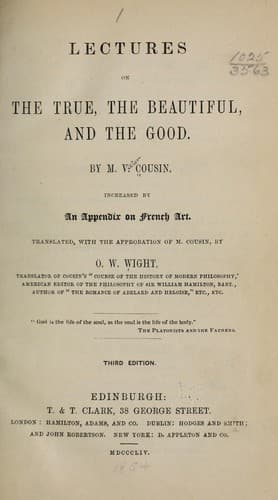
Lectures on the true, the beautiful and the goodCousin, Victor
Philosophy
Lectures on the true, the beautiful and the good
Cousin, Victor
Aesthetics; Ethics; Truth
The notion of the infinite and the perfect is for Descartes what the
universal, the Idea, is for Plato. No sooner has Descartes found by
consciousness that he thinks, than he concludes from this that he
exists, then, in course, by consciousness still, he recognizes himself
as imperfect, full of defects, limitations, miseries, and, at the same
time, conceives something infinite and perfect. He possesses the idea of
the infinite and the perfect; but this idea is not his own work, for he
is imperfect; it must then have been put into him by another being
endowed with perfection, whom he conceives, whom he does not
possess:--that being is God. Such is the process by which Descartes,
setting out from his own thought, and his own being, elevated himself to
God. This process, so simple, which he so simply exposes in the
_Discours de la Methode_, he will put successively, in the
_Meditations_, in the _Responses aux Objections_, in the _Principes_,
under the most diverse forms, he will accommodate it, if it is
necessary, to the language of the schools, in order that it may
penetrate into them. After all, this process is compelled to conclude,
from the idea of the infinite and the perfect, in the existence of a
cause of this idea, adequate, at least, to the idea itself, that is to
say, infinite and perfect. One sees that the first difference between
Plato and Descartes is, that the ideas which in Plato are at once
conceptions of our mind, and the principles of things, are for
Descartes, as well as for all modern philosophy, only our conceptions,
amongst which that of the infinite and perfect occupies the first place;
the second difference is, that Plato goes from ideas to God by the
principle of substances, if we may be allowed to use this technical
language of modern philosophy; whilst Descartes employs rather the
principle of causality, and concludes--well understood without
syllogism--from the idea of the infinite and the perfect in a cause also
perfect and infinite.[58] But under these differences, and in spite of
many more, is a common basis, a genius the same, which at first elevates
us above the senses, and, by the intermediary of marvellous ideas that
are incontestably in us, bears us towards him who alone can be their
substance, who is the infinite and perfect author of our idea of
infinity and perfection. For this reason, Descartes belongs to the
family of Plato and Socrates.
The idea of the perfect and the finite being once introduced into the
philosophy of the seventeenth century, it becomes there for the
successors of Descartes what the theory of ideas became for the
successors of Plato.
Public-domain text, read in full here on John Shaqi.
Reviews
Reviews
No reviews yet
Be the first to share your thoughts on this work.
Elsewhere in the archive
Join the Discussion
Join the discussion
Sign in to leave a comment or review.
Sign InorCreate an account