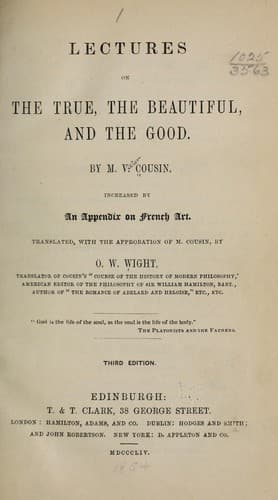
Lectures on the true, the beautiful and the goodCousin, Victor
Philosophy
Lectures on the true, the beautiful and the good
Cousin, Victor
Aesthetics; Ethics; Truth
"There are those who, in order to verify these eternal truths which we
have proposed, and others of the same nature, have figured to themselves
eternal essences aside from deity--a pure illusion, which comes from
not understanding that in God, as in the source of being, and in his
understanding, where resides the art of making and ordering all things,
are found primitive ideas, or as St. Augustine says, the eternally
subsisting reasons of things. Thus, in the thought of the architect is
the primitive idea of a house which he perceives in himself; this
intellectual house would not be destroyed by any ruin of houses built
according to this interior model; and if the architect were eternal, the
idea and the reason of the house would also be eternal. But, without
recurring to the mortal architect, there is an immortal architect, or
rather a primitive eternally subsisting art in the immutable thought of
God, where all order, all measure, all rule, all proportion, all reason,
in a word, all truth are found in their origin.
"These eternal verities which our ideas represent, are the true object
of science; and this is the reason why Plato, in order to render us
truly wise, continually reminds us of these ideas, wherein is seen, not
what is formed, but what is, not what is begotten and is corrupt, what
appears and vanishes, what is made and defective, but what eternally
subsists. It is this intellectual world which that divine philosopher
has put in the mind of God before the world was constructed, which is
the immutable model of that great work. These are the simple, eternal,
immutable, unbegotten, incorruptible ideas to which he refers us, in
order to understand truth. This is what has made him say that our ideas,
images of the divine ideas, were also immediately derived from the
divine ideas, and did not come by the senses, which serve very well,
said he, to awaken them, but not to form them in our mind. For if,
without having ever seen any thing eternal, we have so clear an idea of
eternity, that is to say, of being that is always the same; if, without
having perceived a perfect triangle, we understand it distinctly, and
demonstrate so many incontestable truths concerning it, it is a mark
that these ideas do not come from our senses."
_Treatise on the Knowledge of God and Self._[65] Chap. iv., sect. 5.
_Intelligence has for its object eternal truths, which are nothing else
than God himself, in whom they are always subsisting and perfectly
understood._
Public-domain text, read in full here on John Shaqi.
Reviews
Reviews
No reviews yet
Be the first to share your thoughts on this work.
Elsewhere in the archive
Join the Discussion
Join the discussion
Sign in to leave a comment or review.
Sign InorCreate an account