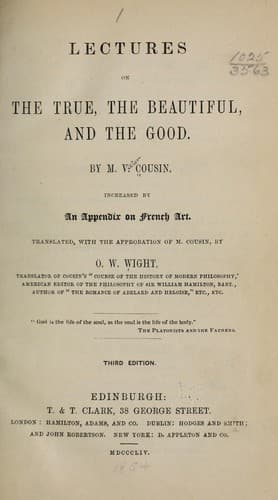
Lectures on the true, the beautiful and the goodCousin, Victor
Philosophy
Lectures on the true, the beautiful and the good
Cousin, Victor
Aesthetics; Ethics; Truth
"... We have already remarked that the understanding has eternal
verities for its object. The standards by which we measure all things
are eternal and invariable. We know clearly that every thing in the
universe is made according to proportion, from the greatest to the
least, from the strongest to the weakest, and we know it well enough to
understand that these proportions are related to the principles of
eternal truth. All that is demonstrated in mathematics, and in any other
science whatever, is eternal and immutable, since the effect of the
demonstration is to show that the thing cannot be otherwise than as it
is demonstrated to be. So, in order to understand the nature and the
properties of things which I know, for example, a triangle, a square, a
circle, or the relations of these figures, and all other figures, to
each other, it is not necessary that I should find such in nature, and I
may be sure that I have never traced, never seen, any that are perfect.
Neither is it necessary that I should think that there is motion in the
world in order to understand the nature of motion itself, or that of the
lines which every motion describes, and the hidden proportions according
to which it is developed. When the idea of these things is once awakened
in my mind, I know that, whether they have an actual existence or not,
so they must be, that it is impossible for them to be of another nature,
or to be made in a different way. To come to something that concerns us
more nearly, I mean by these principles of eternal truth, that they do
not depend on human existence, that, so far as he is capable of
reasoning, it is the essential duty of man to live according to reason,
and to search for his maker, through fear of lacking the recognition of
his maker, if in fault of searching for him, he should be ignorant of
him. All these truths, and all those which I deduce from them by sure
reasoning, subsist independently of all time. In whatever time I place a
human understanding, it will know them, but in knowing them it will find
them truths, it will not make them such, for our cognitions do not make
their objects, but suppose them. So these truths subsist before all
time, before the existence of a human understanding: and were every
thing that is made according to the laws of proportion, that is to say,
every thing that I see in nature, destroyed except myself, these laws
would be preserved in my thought, and I should clearly see that they
would always be good and always true, were I also destroyed with the
rest.
"If I seek how, where, and in what subject they subsist eternal and
immutable, as they are, I am obliged to avow the existence of a being in
whom truth is eternally subsisting, in whom it is always understood; and
this being must be truth itself, and must be all truth, and from him it
is that truth is derived in every thing that exists and has
understanding out of him.
Public-domain text, read in full here on John Shaqi.
Reviews
Reviews
No reviews yet
Be the first to share your thoughts on this work.
Elsewhere in the archive
Join the Discussion
Join the discussion
Sign in to leave a comment or review.
Sign InorCreate an account