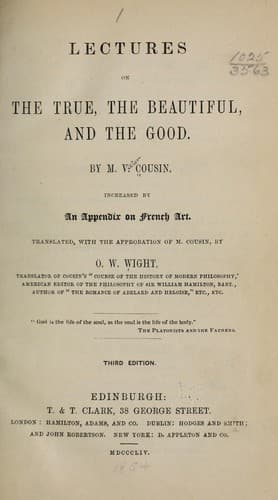
Lectures on the true, the beautiful and the goodCousin, Victor
Philosophy
Lectures on the true, the beautiful and the good
Cousin, Victor
Aesthetics; Ethics; Truth
But in the midst of these high considerations, let us carefully guard
ourselves against two opposite errors, from which men of fine genius
have not always known how to preserve themselves,--against the error of
making the reason of man purely individual, and against the error of
confounding it with truth and the divine reason.[70] If the reason of
man is purely individual because it is in the individual, it can
comprehend nothing that is not individual, nothing that transcends the
limits wherein it is confined. Not only is it unable to elevate itself
to any universal and necessary truth, not only is it unable to have any
idea of it, even any suspicion of it, as one blind from his birth can
have no suspicion that a sun exists; but there is no power, not even
that of God, that by any means could make penetrate the reason of man
any truth of that order absolutely repugnant to its nature; since, for
this end, it would not be sufficient for God to lighten our mind; it
would be necessary to change it, to add to it another faculty. Neither,
on the other hand, must we, with Malebranche, make the reason of man to
such a degree impersonal that it takes the place of truth which is its
object, and of God who is its principle. It is truth that to us is
absolutely impersonal, and not reason. Reason is in man, yet it comes
from God. Hence it is individual and finite, whilst its root is in the
infinite; it is personal by its relation to the person in which it
resides, and must also possess I know not what character of
universality, of necessity even, in order to be capable of conceiving
universal and necessary truths; hence it seems, by turns, according to
the point of view from which it is regarded, pitiable and sublime. Truth
is in some sort lent to human reason, but it belongs to a totally
different reason, to wit, that supreme, eternal, uncreated reason, which
is God himself. The truth in us is nothing else than our object; in God,
it is one of his attributes, as well as justice, holiness, mercy, as we
shall subsequently see. God exists; and so far as he exists, he thinks,
and his thoughts are truths, eternal as himself, which are reflected in
the laws of the universe, which the reason of man has received the power
to attain. Truth is the offspring, the utterance, I was about to say,
the eternal word of God, if it is permitted philosophy to borrow this
divine language from that holy religion which teaches us to worship God
in spirit and in truth. Of old, the theory of Ideas, which manifest God
to men, and remind them of him, had given to Plato the surname of the
precursor; on account of that theory of Ideas he was dear to St.
Augustine, and is invoked by Bossuet. It is by this same theory, wisely
interpreted, and purified by the light of our age, that the new
philosophy is attached to the tradition of great philosophies, and to
that of Christianity.
Public-domain text, read in full here on John Shaqi.
Reviews
Reviews
No reviews yet
Be the first to share your thoughts on this work.
Elsewhere in the archive
Join the Discussion
Join the discussion
Sign in to leave a comment or review.
Sign InorCreate an account