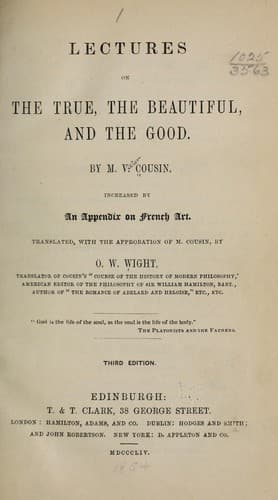
Lectures on the true, the beautiful and the goodCousin, Victor
Philosophy
Lectures on the true, the beautiful and the good
Cousin, Victor
Aesthetics; Ethics; Truth
The last problem that the science of the true presented is resolved:--we
are in possession of the basis of absolute truths. God is substance,
reason, supreme cause, and the unity of all these truths; God, and God
alone, is to us the boundary beyond which we have nothing more to seek.
FOOTNOTES:
[44] See our work entitled, _Metaphysics of Aristotle_, 2d edition,
_passim_. In Aristotle himself, see especially _Metaphysics_, book vii.,
chap. xii., and book xiii., chap. ix.
[45] There are doubtless many other ways of arriving at God, as we shall
successively see; but this is the way of metaphysics. We do not exclude
any of the known and accredited proofs of the existence of God; but we
begin with that which gives all the others. See further on, part ii.,
_God, the Principle of Beauty_, and part iii., _God, the Principle of
the Good_, and the last lecture, which sums up the whole course.
[46] We have said a word on the Platonic theory of ideas, 1st Series,
vol. iv., p. 461 and 522. See also, vol. ii. of the 2d Series, lecture
7, on _Plato and Aristotle_, especially 3d Series, vol. i., a few words
on the _Language of the Theory of Ideas_, p. 121; our work on the
_Metaphysics of Aristotle_, p. 48 and 149, and our translation of Plato,
_passim_.
[47] Aristotle first stated this; modern peripatetics have repeated it;
and after them, all who have wished to decry the ancient philosophy, and
philosophy in general, by giving the appearance of absurdity to its most
illustrious representative.
[48] See particularly p. 121 of the _Timaeus_, vol. xii. of our
translation.
[49] _Republic_, book vi., vol. x. of our translation, p. 57.
[50] _Republic_, book vii., p. 20.
[51] _Phaedrus_, vol. vi., p. 51.
[52] _Phaedrus_, vol. vi., p. 55.
[53] Vol. xi., p. 261.
[54] Edit. Bened., vol. vi., p. 17: _Idex sunt formae quaedam principales
et rationes rerum stabiles atque incommutabiles, quae ipsae formatae non
sunt ac per hoc aeternae ac semper eodem modo sese habentes, quae in divina
intelligentia continentur_....
[55] Edit. Bened., vol. vi., p. 18. _Singula igitur propriis creata sunt
rationibus. Has autem rationes ubi arbitrandum est esse nisi in mente
Creatoris? non enim extra se quidquam intuebatur, ut secundum id
constitueret quod constituebat: nam hoc opinari sacrilegum est._
[56] _Ibid._ See also, book of the _Confessions_, book ii. of the _Free
Will_, book xii. of the _Trinity_, book vii. of the _City of God_, &c.
[57] _Summa totius theologiae_. Primae partis quaest. xii. art. 11. _Ad
tertium dicendum, quod omnia dicimus in Deo videre, et secundum ipsum de
omnibus judicare, in quantum per participationem sui luminis omnia
cognoscimus et dijudicamus. Nam et ipsum lumen naturale rationis
participatio quaedam est divini luminis._
Public-domain text, read in full here on John Shaqi.
Reviews
Reviews
No reviews yet
Be the first to share your thoughts on this work.
Elsewhere in the archive
Join the Discussion
Join the discussion
Sign in to leave a comment or review.
Sign InorCreate an account