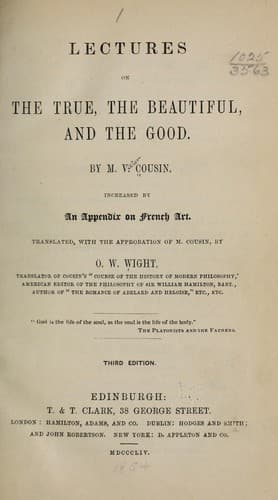
Lectures on the true, the beautiful and the goodCousin, Victor
Philosophy
Lectures on the true, the beautiful and the good
Cousin, Victor
Aesthetics; Ethics; Truth
[70] We have many times designated these two rocks, for example, 2d
Series, vol. i., lecture 5, p. 92:--"One cannot help smiling when, in
our times, he hears individual reason spoken against. In truth it is a
great waste of declamation, for the reason is not individual; if it
were, we should govern it as we govern our resolutions and our
volitions, we could at any moment change its acts, that is to say, our
conceptions. If these conceptions were merely individual, we should not
think of imposing them upon another individual, for to impose our own
individual and personal conceptions on another individual, on another
person, would be the most extravagant despotism.... We call those mad
who do not admit the relations of numbers, the difference between the
beautiful and the ugly, the just and the unjust. Why? Because we know
that it is not the individual that constitutes these conceptions, or, in
other terms, we know that the reason has something universal and
absolute, that upon this ground it obligates all individuals; and an
individual, at the same time that he knows that he himself is obligated
by it, knows that all others are obligated by it on the same
ground."--_Ibid._, p. 93: "Truth misconceived is thereby neither altered
nor destroyed; it subsists independently of the reason that perceives it
or perceives it ill. Truth in itself is independent of our reason. Its
true subject is the universal and absolute reason."
LECTURE V.
ON MYSTICISM.
Distinction between the philosophy that we profess and
mysticism. Mysticism consists in pretending to know God without
an intermediary.--Two sorts of mysticism.--Mysticism of
sentiment. Theory of sensibility. Two sensibilities--the one
external, the other internal, and corresponding to the soul as
external sensibility corresponds to nature.--Legitimate part of
sentiment.--Its aberrations.--Philosophical mysticism. Plotinus:
God, or absolute unity, perceived without an intermediary by
pure thought.--Ecstasy.--Mixture of superstition and abstraction
in mysticism.--Conclusion of the first part of the course.
Public-domain text, read in full here on John Shaqi.
Reviews
Reviews
No reviews yet
Be the first to share your thoughts on this work.
Elsewhere in the archive
Join the Discussion
Join the discussion
Sign in to leave a comment or review.
Sign InorCreate an account