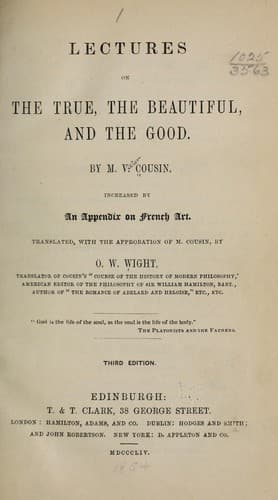
Lectures on the true, the beautiful and the goodCousin, Victor
Philosophy
Lectures on the true, the beautiful and the good
Cousin, Victor
Aesthetics; Ethics; Truth
Whether we turn our attention to the forces and the laws that animate
and govern matter without belonging to it, or as the order of our labors
calls us to do, reflect upon the universal and necessary truths which
our mind discovers but does not constitute, the least systematic use of
reason makes us naturally conclude from the forces and laws of the
universe that there is a first intelligent mover, and from necessary
truths that there is a necessary being who alone is their substance. We
do not perceive God, but we conceive him, upon the faith of this
admirable world exposed to our view, and upon that of this other world,
more admirable still, which we bear in ourselves. By this double road we
succeed in going to God. This natural course is that of all men: it must
be sufficient for a sound philosophy. But there are feeble and
presumptuous minds that do not know how to go thus far, or do not know
how to stop there. Confined to experience, they do not dare to conclude
from what they see in what they do not see, as if at all times, at the
sight of the first phenomenon that appears to their eyes, they did not
admit that this phenomenon has a cause, even when this cause does not
come within the reach of their senses. They do not perceive it, yet they
believe in it, for the simple reason that they necessarily conceive it.
Man and the universe are also facts that cannot but have a cause,
although this cause may neither be seen by our eyes nor touched by our
hands. Reason has been given us for the very purpose of going, and
without any circuit of reasoning, from the visible to the invisible,
from the finite to the infinite, from the imperfect to the perfect, and
also, from necessary and universal truths, which surround us on every
side, to their eternal and necessary principle. Such is the natural and
legitimate bearing of reason. It possesses an evidence of which it
renders no account, and is not thereby less irresistible to whomsoever
does not undertake to contest with God the veracity of the faculties
which he has received. But one does not revolt against reason with
impunity. It punishes our false wisdom by giving us up to extravagance.
When one has confined himself to the narrow limits of what he directly
perceives, he is smothered by these limits, wishes to go out of them at
any price, and invokes some other means of knowing; he did not dare to
admit the existence of an invisible God, and now behold him aspiring to
enter into immediate communication with him, as with sensible objects,
and the objects of consciousness. It is an extreme feebleness for a
rational being thus to doubt reason, and it is an incredible rashness,
in this despair of intelligence, to dream of direct communication with
God. This desperate and ambitious dream is mysticism.
Public-domain text, read in full here on John Shaqi.
Reviews
Reviews
No reviews yet
Be the first to share your thoughts on this work.
Elsewhere in the archive
Join the Discussion
Join the discussion
Sign in to leave a comment or review.
Sign InorCreate an account