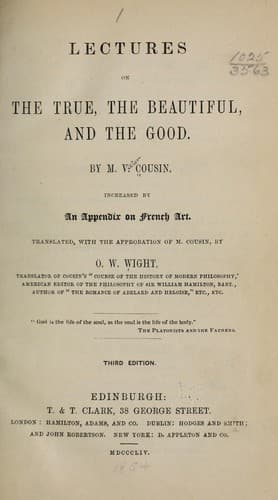
Lectures on the true, the beautiful and the goodCousin, Victor
Philosophy
Lectures on the true, the beautiful and the good
Cousin, Victor
Aesthetics; Ethics; Truth
It is a singular, but incontestable fact, that as soon as reason has
conceived truth, the soul attaches itself to it, and loves it. Yes, the
soul loves truth. It is a wonderful thing that a being strayed into one
corner of the universe, alone charged with sustaining himself against so
many obstacles, who, it would seem, has enough to do to think of
himself, to preserve and somewhat embellish his life, is capable of
loving what is not related to him, and exists only in an invisible
world! This disinterested love of truth gives evidence of the greatness
of him who feels it.
Reason takes one step more:--it is not contented with truth, even
absolute truth, when convinced that it possesses it ill, that it does
not possess it as it really is; as long as it has not placed it upon its
eternal basis; having arrived there, it stops as before its impassable
barrier, having nothing more to seek, nothing more to find. Sentiment
follows reason, to which it is attached; it stops, it rests, only in the
love of the infinite being.
In fact, it is the infinite that we love, while we believe that we are
loving finite things, even while loving truth, beauty, virtue. And so
surely is it the infinite itself that attracts and charms us, that its
highest manifestations do not satisfy us until we have referred them to
their immortal source. The heart is insatiable, because it aspires after
the infinite. This sentiment, this need of the infinite, is at the
foundation of the greatest passions, and the most trifling desires. A
sigh of the soul in the presence of the starry heavens, the melancholy
attached to the passion of glory, to ambition, to all the great emotions
of the soul, express it better without doubt, but they do not express it
more than the caprice and mobility of those vulgar loves, wandering from
object to object in a perpetual circle of ardent desires, of poignant
disquietudes, and mournful disenchantments.
Let us designate another relation between reason and sentiment.
The mind at first precipitates itself towards its object without
rendering to itself an account of what it does, of what it perceives, of
what it feels. But, with the faculty of thinking, of feeling, it has
also that of willing; it possesses the liberty of returning to itself,
of reflecting on its own thought and sentiment, of consenting to this,
or of resisting it, of abstaining from it, or of reproducing its thought
and sentiment, while stamping them with a new character. Spontaneity,
reflection,--these are the two great forms of intelligence.[71] One is
not the other; but, after all, the latter does little more than develop
the former; they contain at bottom the same things:--the point of view
alone is different. Every thing that is spontaneous is obscure and
confused; reflection carries with it a clear and distinct view.
Public-domain text, read in full here on John Shaqi.
Reviews
Reviews
No reviews yet
Be the first to share your thoughts on this work.
Elsewhere in the archive
Join the Discussion
Join the discussion
Sign in to leave a comment or review.
Sign InorCreate an account