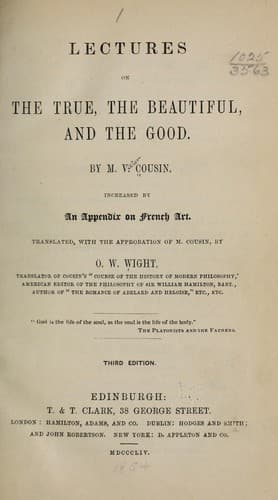
Lectures on the true, the beautiful and the goodCousin, Victor
Philosophy
Lectures on the true, the beautiful and the good
Cousin, Victor
Aesthetics; Ethics; Truth
Reason does not begin by reflection; it does not at first perceive the
truth as universal and necessary; consequently, when it passes from idea
to being, when it refers truth to the real being that is its subject, it
has not sounded, it even has no suspicion of the depth of the chasm it
passes; it passes it by means of the power which is in it, but it is not
astonished at what it has done. It is subsequently astonished, and
undertakes by the aid of the liberty with which it is endowed, to do the
opposite of what it has done, to deny what it has affirmed. Here
commences the strife between sophism and common sense, between false
science and natural truth, between good and bad philosophy, both of
which come from free reflection. The sad and sublime privilege of
reflection is error; but reflection is the remedy for the evil it
produces. If it can deny natural truth, usually it confirms it, returns
to common sense by a longer or shorter circuit; it opposes in vain all
the tendencies of human nature, by which it is almost always overcome,
and brought back submissive to the first inspirations of reason,
fortified by this trial. But there is nothing more in the end than there
was at the beginning; only in primitive inspiration there was a power
which was ignorant of itself, and in the legitimate results of
reflection there is a power which knows itself:--one is the triumph of
instinct, the other, that of true science.
Sentiment which accompanies intelligence in all its proceedings presents
the same phenomena.
Public-domain text, read in full here on John Shaqi.
Reviews
Reviews
No reviews yet
Be the first to share your thoughts on this work.
Elsewhere in the archive
Join the Discussion
Join the discussion
Sign in to leave a comment or review.
Sign InorCreate an account