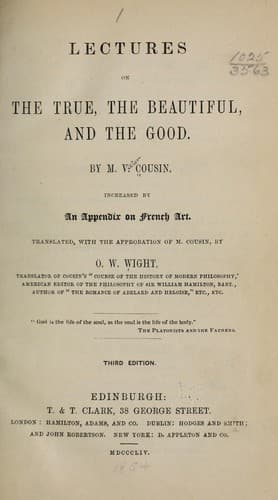
Lectures on the true, the beautiful and the goodCousin, Victor
Philosophy
Lectures on the true, the beautiful and the good
Cousin, Victor
Aesthetics; Ethics; Truth
The Alexandrian mysticism is the most learned and the profoundest of all
known mysticisms. In the heights of abstraction where it loses itself,
it seems very far from popular superstitions; and yet the school of
Alexandria unites ecstatic contemplation and theurgy. These are two
things, in appearance, incompatible, but they pertain to the same
principle, to the pretension of directly perceiving what inevitably
escapes all our efforts. On the one hand, a refined mysticism aspires to
God by ecstasy; on the other, a gross mysticism thinks to seize him by
the senses. The processes, the faculties employed, differ, but the
foundation is the same, and from this common foundation necessarily
spring the most opposite extravagances. Apollonius of Tyanus is a
popular Alexandrianist, and Jamblicus is Plotinus become a priest,
mystagogue, and hierophant. A new worship shone forth by miracles; the
ancient worship would have its own miracles, and philosophers boasted
that they could make the divinity appear before other men. They had
demons for themselves, and, in some sort, for their own orders; the gods
were not only invoked, but evoked. Ecstasy for the initiates, theurgy
for the crowd.
At all times and in all places, these two mysticisms have given each
other the hand. In India and in China, the schools where the most
subtile idealism is taught, are not far from pagodas of the most abject
idolatry. One day the Bhagavad-Gita or Lao-tseu[91] is read, an
indefinable God is taught, without essential and determinate attributes;
the next day there is shown to the people such or such a form, such or
such a manifestation of this God, who, not having a form that belongs to
him, can receive all forms, and being only substance in itself, is
necessarily the substance of every thing, of a stone and a drop of
water, of a dog, a hero, and a sage. So, in the ancient world under
Julien, for example, the same man was at once professor in the school of
Athens and guardian of the temple of Minerva or Cybele, by turns
obscuring the _Timaeus_ and the _Republic_ by subtile commentaries, and
exhibiting to the eyes of the multitude sometimes the sacred vale,[92]
sometimes the shrine of the good goddess,[93] and in either function, as
priest or philosopher, imposing on others and himself, under taking to
ascend above the human mind and falling miserably below it, paying in
some sort the penalty of an unintelligible metaphysics, in lending
himself to the most shameless superstitions.
Public-domain text, read in full here on John Shaqi.
Reviews
Reviews
No reviews yet
Be the first to share your thoughts on this work.
Elsewhere in the archive
Join the Discussion
Join the discussion
Sign in to leave a comment or review.
Sign InorCreate an account