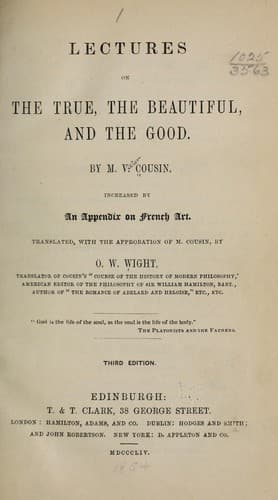
Lectures on the true, the beautiful and the goodCousin, Victor
Philosophy
Lectures on the true, the beautiful and the good
Cousin, Victor
Aesthetics; Ethics; Truth
abstract unity, it is the precise unity of perfect being in which every
thing is accomplished. At the summit of existence, still more than at
its low degree, every thing is determinate, every thing is developed,
every thing is distinct, every thing is one. The richness of
determinations is a certain sign of the plenitude of being. Reflection
distinguishes these determinations from each other, but it is not
necessary that it should in these distinctions see the limits. In us,
for example, does the diversity of our faculties and their richest
development divide the _me_ and alter the identity and the unity of the
person? Does each one of us believe himself less than himself, because
he possesses sensibility, reason, and will? No, surely. It is the same
with God. Not having employed a sufficient psychology, Alexandrian
mysticism imagined that diversity of attributes is incompatible with
simplicity of essence, and through fear of corrupting simple and pure
essence, it made of it an abstraction. By a senseless scruple, it feared
that God would not be sufficiently perfect, if it left him all his
perfections; it regards them as imperfections, being as a degradation,
creation as a fall; and, in order to explain man and the universe, it is
forced to put in God what it calls failings, not having seen that these
pretended failings are the very signs of his infinite perfection.
The theory of ecstasy is at once the necessary condition and the
condemnation of the theory of absolute unity. Without absolute unity as
the direct object of knowledge, of what use is ecstasy in the subject of
knowledge? Ecstasy, far from elevating man to God, abases him below man;
for it effaces in him thought, by taking away its condition, which is
consciousness. To suppress consciousness, is to render all knowledge
impossible; it is not to comprehend the perfection of this mode of
knowing, wherein the limitation of subject and object gives at once the
simplest, most immediate, and most determinate knowledge.[90]
Public-domain text, read in full here on John Shaqi.
Reviews
Reviews
No reviews yet
Be the first to share your thoughts on this work.
Elsewhere in the archive
Join the Discussion
Join the discussion
Sign in to leave a comment or review.
Sign InorCreate an account