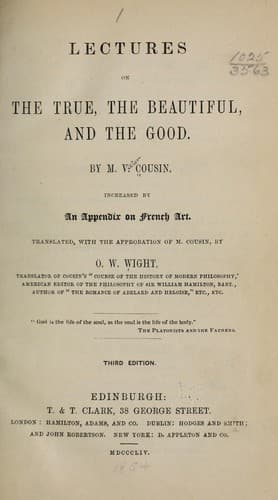
Lectures on the true, the beautiful and the goodCousin, Victor
Philosophy
Lectures on the true, the beautiful and the good
Cousin, Victor
Aesthetics; Ethics; Truth
[77] See especially in our writings the regular and detailed refutation
of the double extravagance of considering substance apart from its
determinations and its qualities, or of considering its qualities and
its facilities apart from the being that possesses them. 1st Series,
vol. iii., lecture 3, _On Condillac_, and vol. v., lectures 5 and 6, _On
Kant_. We say, the same Series, vol. iv., p. 56: "There are philosophers
beyond the Rhine, who, to appear very profound, are not contented with
qualities and phenomena, and aspire to pure substance, to being in
itself. The problem stated as follows, is quite insoluble: the knowledge
of such a substance is impossible, for this very simple reason, that
such a substance does not exist. Being in itself, _das Ding in sich_,
which Kant seeks, escapes him, and this does not humiliate Kant and
philosophy; for there is no being in itself. The human mind may form to
itself an abstract and general idea of being, but this idea has no real
object in nature. All being is determinate, if it is real; and to be
determinate is to possess certain modes of being, transitory and
accidental, or constant and essential. Knowledge of being in itself is
then not merely interdicted to the human mind; it is contrary to the
nature of things. At the other extreme of metaphysics is a powerless
psychology, which, by fear of a hollow ontology, is condemned to
voluntary ignorance. We are not able, say these philosophers, Mr. Dugald
Stewart, for example, to attain being in itself; it is permitted us to
know only phenomena and qualities: so that, in order not to wander in
search of the substance of the soul, they do not dare affirm its
spirituality, and devote themselves to the study of its different
faculties. Equal error, equal chimera! There are no more qualities
without being, than being without qualities. No being is without its
determinations, and reciprocally its determinations are not without it.
To consider the determinations of being independently of the being which
possesses them, is no longer to observe; it is to abstract, to make an
abstraction quite as extravagant as that of being considered
independently of its qualities."
[78] On the school of Alexandria, see 2d Series, vol. ii., _Sketch of a
General History of Philosophy_, lecture 8, p. 211, and 3d Series, vol.
i., _passim_.
[79] See the previous lecture.
[80] 3d Series, vol. i., _Ancient Philosophy_, article _Xenophanes_, and
article _Zeno_.
[81] _The Sophist_, vol. xi. of our translation, p. 261.
[82] _Timaeus_, vol. xii., p. 117.
[83] _Republic_, book vii., p. 70 of vol. x.
[84] _Phaedrus_, vol. vi., p. 55.
Public-domain text, read in full here on John Shaqi.
Reviews
Reviews
No reviews yet
Be the first to share your thoughts on this work.
Elsewhere in the archive
Join the Discussion
Join the discussion
Sign in to leave a comment or review.
Sign InorCreate an account