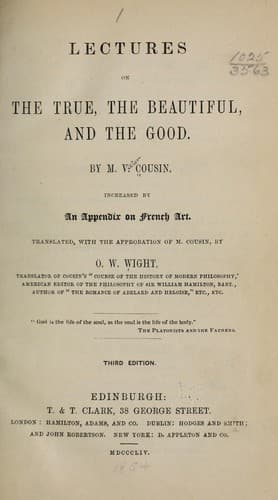
Lectures on the true, the beautiful and the goodCousin, Victor
Philosophy
Lectures on the true, the beautiful and the good
Cousin, Victor
Aesthetics; Ethics; Truth
[85] _The Sophist_, p. 261, 262. The following little-known and decisive
passage, which we have translated for the first time, must be
cited:--"_Stranger._ But what, by Zeus! shall we be so easily persuaded
that in reality, motion, life, soul, intelligence, do not belong to
absolute being? that this being neither lives nor thinks, that this
being remains immobile, immutable, without having part in august and
holy intelligence?--_Theatetus._ That would be consenting, dear Eleatus,
to a very strange assertion.--_Stranger._ Or, indeed, shall we accord to
this being intelligence while we refuse him life?--_Theatetus._ That
cannot be.--_Stranger._ Or, again, shall we say that there is in him
intelligence and life, but that it is not in a soul that he possesses
them?--_Theatetus._ And how could he possess them otherwise?--_Stranger._
In fine, that, endowed with intelligence, soul, and life, all animated
as he is, he remains incomplete immobility.--_Theatetus._ All that seems
to me unreasonable."
[86] _Timaeus_, p. 119: "Let us say that the cause which led the supreme
ordainer to produce and compose this universe was, that he was good."
[87] _Bouquet_, discourse of Diotimus, vol. vi., and the 2d part of this
vol., _The Beautiful_, lecture 7.
[88] _Republic._ _Ibid._
[89] Book xii. of the _Metaphysics_. _De la Metaphysique d'Aristotle_,
2d edition, p. 200, etc.
[90] On this fundamental point, see lecture 3, in this vol.--2d Series,
vol. i., lecture 5, p. 97. "The peculiarity of intelligence is not the
power of knowing, but knowing in fact. On what condition is there
intelligence for us? It is not enough that there should be in us a
principle of intelligence; this principle must be developed and
exercised, and take itself as the object of its intelligence. The
necessary condition of intelligence is consciousness--that is to say,
difference. There can be consciousness only where there are several
terms, one of which perceives the other, and at the same time perceives
itself. That is knowing, and knowing self; that is intelligence.
Intelligence without consciousness is the abstract possibility of
intelligence, it is not real intelligence. Transfer this from human
intelligence to divine intelligence, that is to say, refer ideas, I mean
ideas in the sense of Plato, of St. Augustine, of Bossuet, of Leibnitz,
to the only intelligence to which they can belong, and you will have, if
I may thus express myself, the life of the divine intelligence ...,
etc."
[91] Vol. ii. of the 2d Series, _Sketch of a General History of
Philosophy_, lectures 5 and 6, _On the Indian Philosophy_.
[92] See the _Euthyphron_, vol. i. of our translation.
[93] Lucien, Apuleius, Lucius of Patras.
[94] 2d Series, vol. ii., _Sketch of a General History of Philosophy_,
lecture 10, _On the Philosophy of the Renaissance_.
Public-domain text, read in full here on John Shaqi.
Reviews
Reviews
No reviews yet
Be the first to share your thoughts on this work.
Elsewhere in the archive
Join the Discussion
Join the discussion
Sign in to leave a comment or review.
Sign InorCreate an account