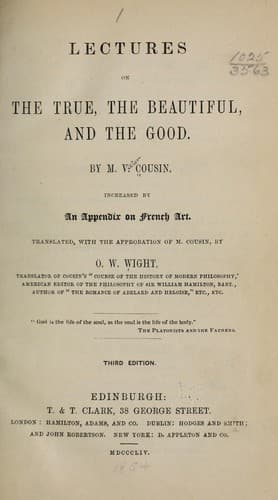
Lectures on the true, the beautiful and the goodCousin, Victor
Philosophy
Lectures on the true, the beautiful and the good
Cousin, Victor
Aesthetics; Ethics; Truth
has the right to dispose of it arbitrarily, and when we say: this is
true, this is beautiful, it is no longer the particular and variable
impression of our sensibility that we express, it is the absolute
judgment that reason imposes on all men.
Confound reason and sensibility, reduce the idea of the beautiful to the
sensation of the agreeable, and taste no longer has a law. If a person
says to me, in the presence of the Apollo Belvidere, that he feels
nothing more agreeable than in presence of any other statue, that it
does not please him at all, that he does not feel its beauty, I cannot
dispute his impression; but if this person thence concludes that the
Apollo is not beautiful, I proudly contradict him, and declare that he
is deceived. Good taste is distinguished from bad taste; but what does
this distinction signify, if the judgment of the beautiful is resolved
into a sensation? You say to me that I have no taste. What does that
mean? Have I not senses like you? Does not the object which you admire
act upon me as well as upon you? Is not the impression which I feel as
real as that which you feel? Whence comes it, then, that you are
right,--you who only give expression to the impression which you feel,
and that I am wrong,--I who do precisely the same thing? Is it because
those who feel like you are more numerous than those who feel like me?
But here the number of voices means nothing? The beautiful being defined
as that which produces on the senses an agreeable impression, a thing
that pleases a single man, though it were frightfully ugly in the eyes
of all the rest of the human race, must, nevertheless, and very
legitimately, be called beautiful by him who receives from it an
agreeable impression, for, so far as he is concerned, it satisfies the
definition. There is, then, no true beauty; there are only relative and
changing beauties, beauties of circumstance, custom, fashion, and all
these beauties, however different, will have a right to the same
respect, provided they meet sensibilities to which they are agreeable.
And as there is nothing in this world, in the infinite diversity of our
dispositions, which may not please some one, there will be nothing that
is not beautiful; or, to speak more truly, there will be nothing either
beautiful or ugly, and the Hottentot Venus will equal the Venus de
Medici. The absurdity of the consequences demonstrates the absurdity of
the principle. But there is only one means of escaping these
consequences, which is to repudiate the principle, and recognize the
judgment of the beautiful as an absolute judgment, and, as such,
entirely different from sensation.
Public-domain text, read in full here on John Shaqi.
Reviews
Reviews
No reviews yet
Be the first to share your thoughts on this work.
Elsewhere in the archive
Join the Discussion
Join the discussion
Sign in to leave a comment or review.
Sign InorCreate an account