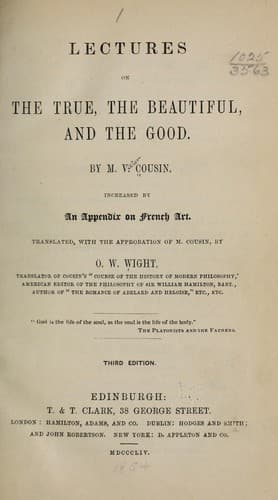
Lectures on the true, the beautiful and the goodCousin, Victor
Philosophy
Lectures on the true, the beautiful and the good
Cousin, Victor
Aesthetics; Ethics; Truth
Far from this, whilst all our senses give us agreeable sensations, only
two have the privilege of awakening in us the idea of beauty. Does one
ever say: This is a beautiful taste, this is a beautiful smell?
Nevertheless, one should say it, if the beautiful is the agreeable. On
the other hand, there are certain pleasures of odor and taste that move
sensibility more than the greatest beauties of nature and art; and even
among the perceptions of hearing and sight, those are not always the
most vivid that most excite in us the idea of beauty. Do not pictures,
ordinary in coloring, often move us more deeply than many dazzling
productions, more seductive to the eye, less touching to the soul? I say
farther; sensation not only does not produce the idea of the beautiful,
but sometimes stifles it. Let an artist occupy himself with the
reproduction of voluptuous forms; while pleasing the senses, he
disturbs, he repels in us the chaste and pure idea of beauty. The
agreeable is not, then, the measure of the beautiful, since in certain
cases it effaces it and makes us forget it; it is not, then, the
beautiful, since it is found, and in the highest degree, where the
beautiful is not.
This conducts us to the essential foundation of the distinction between
the idea of the beautiful and the sensation of the agreeable, to wit,
the difference already explained between sensibility and reason.
When an object makes you experience an agreeable sensation, if one asks
you why this object is agreeable to you, you can answer nothing, except
that such is your impression; and if one informs you that this same
object produces upon others a different impression and displeases them,
you are not much astonished, because you know that sensibility is
diverse, and that sensations must not be disputed. Is it the same when
an object is not only agreeable to you, but when you judge that it is
beautiful? You pronounce, for example, that this figure is noble and
beautiful, that this sunrise or sunset is beautiful, that
disinterestedness and devotion are beautiful, that virtue is beautiful;
if one contests with you the truth of these judgments, then you are not
as accommodating as you were just now; you do not accept the dissent as
an inevitable effect of different sensibilities, you no longer appeal to
your sensibility which naturally terminates in you, you appeal to an
authority which is made for others as well as you, that of reason; you
believe that you have the right of accusing him with error who
contradicts your judgment, for here your judgment rests no longer on
something variable and individual, like an agreeable or painful
sensation. The agreeable is confined for us within the inclosure of our
own organization, where it changes every moment, according to the
perpetual revolutions of this organization, according to health and
sickness, the state of the atmosphere, that of our nerves, etc. But it
is not so with beauty; beauty, like truth, belongs to none of us; no one
Public-domain text, read in full here on John Shaqi.
Reviews
Reviews
No reviews yet
Be the first to share your thoughts on this work.
Elsewhere in the archive
Join the Discussion
Join the discussion
Sign in to leave a comment or review.
Sign InorCreate an account