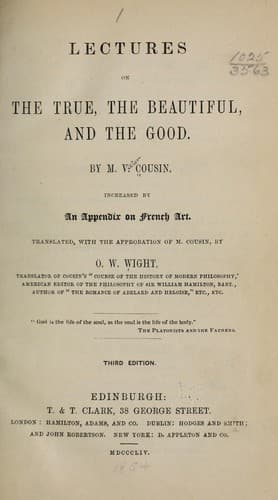
Lectures on the true, the beautiful and the goodCousin, Victor
Philosophy
Lectures on the true, the beautiful and the good
Cousin, Victor
Aesthetics; Ethics; Truth
Place yourself before an object of nature, wherein men recognize beauty,
and observe what takes place within you at the sight of this object. Is
it not certain that, at the same time that you judge that it is
beautiful, you also feel its beauty, that is to say, that you experience
at the sight of it a delightful emotion, and that you are attracted
towards this object by a sentiment of sympathy and love? In other cases
you judge otherwise, and feel an opposite sentiment. Aversion
accompanies the judgment of the ugly, as love accompanies the judgment
of the beautiful. And this sentiment is awakened not only in presence of
the objects of nature: all objects, whatever they may be, that we judge
to be ugly or beautiful, have the power to excite in us this sentiment.
Vary the circumstances as much as you please, place me before an
admirable edifice or before a beautiful landscape; represent to my mind
the great discoveries of Descartes and Newton, the exploits of the
great Conde, the virtue of St. Vincent de Paul; elevate me still higher;
awaken in me the obscure and too much forgotten idea of the infinite
being; whatever you do, as often as you give birth within me to the idea
of the beautiful, you give me an internal and exquisite joy, always
followed by a sentiment of love for the object that caused it.
The more beautiful the object is, the more lively is the joy which it
gives the soul, and the more profound is the love without being
passionate. In admiration judgment rules, but animated by sentiment. Is
admiration increased to the degree of impressing upon the soul an
emotion, an ardor that seems to exceed the limits of human nature? this
state of the soul is called enthusiasm:
"Est Deus in nobis, agitante calescimus illo."
The philosophy of sensation explains sentiment, as well as the idea of
the beautiful, only by changing its nature. It confounds it with
agreeable sensation, and, consequently, for it the love of beauty can be
nothing but desire. There is no theory more contradicted by facts.
What is desire? It is an emotion of the soul which has, for its avowed
or secret end, possession. Admiration is in its nature respectful,
whilst desire tends to profane its object.
Desire is the offspring of need. It supposes, then, in him who
experiences it, a want, a defect, and, to a certain point, suffering.
The sentiment of the beautiful is to itself its own satisfaction.
Public-domain text, read in full here on John Shaqi.
Reviews
Reviews
No reviews yet
Be the first to share your thoughts on this work.
Elsewhere in the archive
Join the Discussion
Join the discussion
Sign in to leave a comment or review.
Sign InorCreate an account