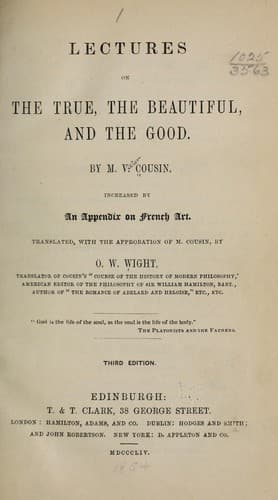
Lectures on the true, the beautiful and the goodCousin, Victor
Philosophy
Lectures on the true, the beautiful and the good
Cousin, Victor
Aesthetics; Ethics; Truth
Desire is burning, impetuous, sad. The sentiment of the beautiful, free
from all desire, and always without fear, elevates and warms the soul,
and may transport it even to enthusiasm, without making it know the
troubles of passion. The artist sees only the beautiful where the
sensual man sees only the alluring and the frightful. On a vessel tossed
by a tempest, while the passengers tremble at the sight of the
threatening waves, and at the sound of the thunder that breaks over
their heads, the artist remains absorbed in the contemplation of the
sublime spectacle. Vernet has himself lashed to the mast in order to
contemplate for a longer time the storm in its majestic and terrible
beauty. When he knows fear, when he participates in the common feeling,
the artist vanishes, there no more remains any thing but the man.
The sentiment of the beautiful is so far from being desire, that each
excludes the other. Let me take a common example. Before a table loaded
with meats and delicious wines, the desire of enjoyment is awakened, but
not the sentiment of the beautiful. Suppose that if, instead of thinking
of the pleasures which all these things spread before my eyes promise
me, I only take notice of the manner in which they are arranged and set
upon the table, and the order of the feast, the sentiment of the
beautiful might in some degree be produced; but surely this will be
neither the need nor the desire of appropriating this symmetry, this
order.
It is the property of beauty not to irritate and inflame desire, but to
purify and ennoble it. The more beautiful a woman is,--I do not mean
that common and gross beauty which Reubens in vain animates with his
brilliant coloring, but that ideal beauty which antiquity and Raphael
understood so well,--the more, at the sight of this noble creature is
desire tempered by an exquisite and delicate sentiment, and is sometimes
even replaced by a disinterested worship. If the Venus of the Capitol,
or the Saint Cecilia, excites in you sensual desires, you are not made
to feel the beautiful. So the true artist addresses himself less to the
senses than to the soul; in painting beauty he only seeks to awaken in
us sentiment; and when he has carried this sentiment as far as
enthusiasm, he has obtained the last triumph of art.
The sentiment of the beautiful is, therefore, a special sentiment, as
the idea of the beautiful is a simple idea. But is this sentiment, one
in itself, manifested only in a single way, and applied only to a single
kind of beauty? Here again--here, as always--let us interrogate
experience.
Public-domain text, read in full here on John Shaqi.
Reviews
Reviews
No reviews yet
Be the first to share your thoughts on this work.
Elsewhere in the archive
Join the Discussion
Join the discussion
Sign in to leave a comment or review.
Sign InorCreate an account