Legends and Satires from Mediæval Literature — John Shaqi
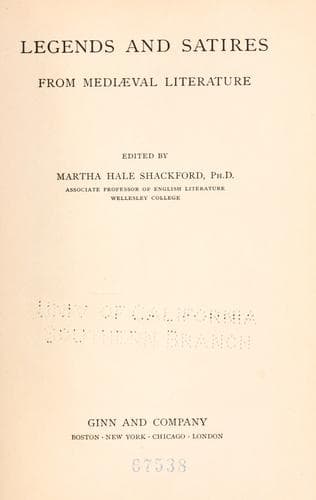
Legends and Satires from Mediæval Literature
History
Legends and Satires from Mediæval Literature
Literature, Medieval
Frontispiece 161
Proem 161
Debate 161
Vision 163
Saints' Lives 165
Pious Tales 167
Allegory 168
Bestiary 169
Lapidary 170
Homily 172
Satire 172
Lay 174
INTRODUCTION
To create anew the walls and towers and gardens of the mediæval
world is a comparatively easy task, now that we have so many aids to
visualizing that departed age, but it is not so easy to make live again
the thoughts and sentiments and beliefs of a vanished generation. All
our study of history is valueless unless it brings a clearer revelation
of the pulsing, ardent life of humanity. We search old records and
old literature that we may find the true image of a world whose hopes
and fears and loves prove to us the slow evolution of a progressive
civilization in which all human beings share. Out of the failures and
the doubts of one age comes the quicker power of another, and true
progress looks both backward and forward. To cherish old traditions is
both a duty and an inspiration.
The reader who turns his face toward the world of mediæval England
and France, seeking to know the spirit which animated our ancestors
of six centuries ago, must recognize in plowman, hermit, knight,
friar, or minstrel the fundamental fact that their life was actual and
real, not a mere tissue of mediæval costume and mechanical movements.
In order to understand that epoch it is essential for one to study
in detail the works which picture the life of the day. The world of
chivalry, with its brilliant pageantry and its vows of courtesy,
loyalty, and liberality, is revealed in the pages of Froissart and in
the many metrical romances, where various aspects of knightly life
are described. "King Horn," "Guy of Warwick," "Libeaus Desconus," "Sir
Eglamour," "The Squire of Low Degree," and others tell the story of
knighthood.
Another world is represented in "Piers Plowman," where the oppression
of the poor by the arrogant rich and the corruption of church and state
are described in racy vernacular by one whose soul was on fire with
devotion to truth and justice. Social problems are enunciated, and the
misery wrought by human ignorance and selfishness is depicted in satire
keen, shrewd, and piercing.
Chaucer, the supreme poet of the fourteenth century in England,
portrays a world of normal folk who represent all classes and
conditions except the very high and the very low. While, in certain
ways, Chaucer's work is easier to read and understand than that of any
of his contemporaries, students often read it very superficially and
fail to recognize the deeply rooted traits which show that Chaucer
was the child of his epoch. We find in the English poet traces of the
influence of Continental life and literature; we see him reading the
classics of Rome, of Florence, and of Paris; but he was also always
intimately familiar with the minor literature popular among his own
countrymen.
Public-domain text, read in full here on John Shaqi.
Reviews
Reviews
No reviews yet
Be the first to share your thoughts on this work.
Join the Discussion
Join the discussion
Sign in to leave a comment or review.
Sign InorCreate an account