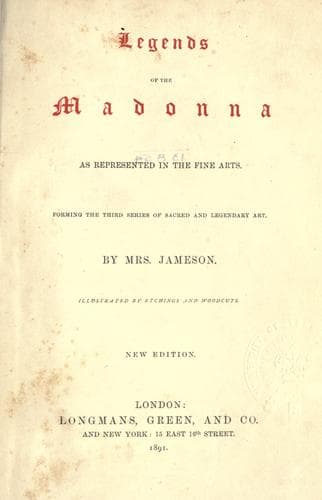
Legends of the Madonna as Represented in the Fine ArtsJameson, Mrs. (Anna)
Religion
Legends of the Madonna as Represented in the Fine Arts
Jameson, Mrs. (Anna)
Christian saints in art; Mary, Blessed Virgin, Saint -- Art; Mary, Blessed Virgin, Saint -- Legends
With regard to costume, the colours in which the enthroned
Virgin-Mother was arrayed scarcely ever varied from the established
rule: her tunic was to be red, her mantle blue; red, the colour of
love, and religious aspiration; blue, the colour of constancy and
heavenly purity. In the pictures of the thirteenth and fourteenth
centuries, and down to the early part of the fifteenth, these colours
are of a soft and delicate tint,--rose and pale azure; but afterwards,
when powerful effects of colour became a study, we have the intense
crimson, and the dark blue verging on purple. Sometimes the blue
mantle is brought over her head, sometimes she wears a white veil, in
other instances the queenly crown. Sometimes (but very rarely when she
is throned as the _Regina Coeli_) she has no covering or ornament on
her head; and her fair hair parted on her brow, flows down on either
side in long luxuriant tresses.
In the Venetian and German pictures, she is often most gorgeously
arrayed; her crown studded with jewels, her robe covered with
embroidery, or bordered with gold and pearls. The ornamental parts of
her dress and throne were sometimes, to increase the magnificence of
the effect, raised in relief and gilt. To the early German painters,
we might too often apply the sarcasm of Apelles, who said of his
rival, that, "not being able to make Venus _beautiful_ he had made
her _fine_;" but some of the Venetian Madonnas are lovely as well as
splendid. Gold was often used, and in great profusion, in some of the
Lombard pictures even of a late date; for instance, by Carlo Crivelli:
before the middle of the sixteenth century, this was considered
barbaric. The best Italian painters gave the Virgin ample, well
disposed drapery, but dispensed with ornament. The star embroidered on
her shoulder, so often retained when all other ornament was banished,
expresses her title "Stella Maris." I have seen some old pictures, in
which she wears a ring on the third finger. This expresses her dignity
as the _Sposa_ as well as the Mother.
Public-domain text, read in full here on John Shaqi.
Reviews
Reviews
No reviews yet
Be the first to share your thoughts on this work.
Elsewhere in the archive
Join the Discussion
Join the discussion
Sign in to leave a comment or review.
Sign InorCreate an account