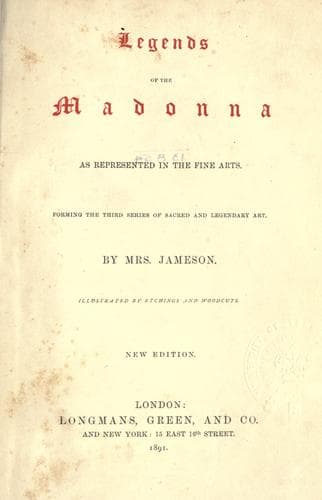
Legends of the Madonna as Represented in the Fine ArtsJameson, Mrs. (Anna)
Religion
Legends of the Madonna as Represented in the Fine Arts
Jameson, Mrs. (Anna)
Christian saints in art; Mary, Blessed Virgin, Saint -- Art; Mary, Blessed Virgin, Saint -- Legends
With regard to the divine Infant, he is, in the early pictures,
invariably draped, and it is not till the beginning of the fifteenth
century that we find him first partially and then wholly undraped.
In the old representations, he wears a long tunic with full sleeves,
fastened with a girdle. It is sometimes of gold stuff embroidered,
sometimes white, crimson, or blue. This almost regal robe was
afterwards exchanged for a little semi-transparent shirt without
sleeves. In pictures of the throned Madonna painted expressly for
nunneries, the Child is, I believe, always clothed, or the Mother
partly infolds him in her own drapery. In the Umbrian pictures of the
fifteenth century, the Infant often wears a coral necklace, then and
now worn by children in that district, as a charm against the evil
eye. In the Venetian pictures he has sometimes a coronal of pearls. In
the carved and painted images set up in churches, he wears, like his
mother, a rich crown over a curled wig, and is hung round with jewels;
but such images must be considered as out of the pale of legitimate
art.
* * * * *
Of the various objects placed in the hand of the Child as emblems I
have already spoken, and of their sacred significance as such,--the
globe, the book, the bird, the flower, &c. In the works of the
ignorant secular artists of later times, these symbols of power, or
divinity, or wisdom, became mere playthings; and when they had become
familiar, and required by custom, and the old sacred associations
utterly forgotten, we find them most profanely applied and misused.
To give one example:--the bird was originally placed in the hand of
Christ as the emblem of the soul, or of the spiritual as opposed to
the earthly nature; in a picture by Baroccio, he holds it up before
a cat, to be frightened and tormented.[1] But to proceed.
[Footnote 1: In the "History of Our Lord, as illustrated in the
Fine Arts," the devotional and characteristic effigies of the infant
Christ, and the accompanying attributes, will be treated at length.]
Public-domain text, read in full here on John Shaqi.
Reviews
Reviews
No reviews yet
Be the first to share your thoughts on this work.
Elsewhere in the archive
Join the Discussion
Join the discussion
Sign in to leave a comment or review.
Sign InorCreate an account