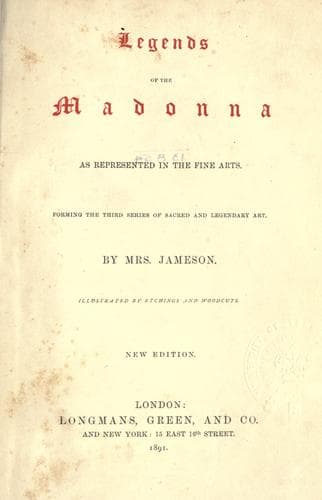
Legends of the Madonna as Represented in the Fine ArtsJameson, Mrs. (Anna)
Religion
Legends of the Madonna as Represented in the Fine Arts
Jameson, Mrs. (Anna)
Christian saints in art; Mary, Blessed Virgin, Saint -- Art; Mary, Blessed Virgin, Saint -- Legends
"Created beings all in lowliness
Surpassing, as in height above them all."
It is time to change the scene,--to contemplate the Virgin, as she
has been exhibited to us in the relations of earthly life, as the mere
woman, acting and suffering, loving, living, dying, fulfilling the
highest destinies in the humblest state, in the meekest spirit. So
we begin her history as the ancient artists have placed it before us,
with that mingled _naïveté_ and reverence, that vivid dramatic power,
which only faith, and love, and genius united, could impart.
HISTORICAL SUBJECTS
PART I.
THE LIFE OF THE VIRGIN MARY FROM HER BIRTH TO HER MARRIAGE WITH
JOSEPH.
1. THE LEGEND OF JOACHIM AND ANNA.
2. THE NATIVITY OF THE BLESSED VIRGIN.
3. THE DEDICATION IN THE TEMPLE.
4. THE MARRIAGE WITH JOSEPH.
THE LEGEND OF JOACHIM AND ANNA.
_Ital._ La Leggenda di Sant' Anna Madre della Gloriosa Vergine Maria,
e di San Gioacchino.
Of the sources whence are derived the popular legends of the life of
the Virgin Mary, which, mixed up with the few notices in Scripture,
formed one continuous narrative, authorized by the priesthood, and
accepted and believed in by the people, I have spoken at length in the
Introduction. We have now to consider more particularly the scenes and
characters associated with her history; to show how the artists of the
Middle Ages, under the guidance and by the authority of the Church,
treated in detail these favourite themes in ecclesiastical decoration.
In early art, that is, up to the end of the fifteenth century, Joachim
and Anna, the parents of the Virgin, never appear except in the series
of subjects from her life. In the devotional groups and altar-pieces,
they are omitted. St. Bernard, the great theological authority of
those times, objects to the invocation of any saints who had lived
before the birth of Christ, consequently to their introduction
into ecclesiastical edifices in any other light than as historical
personages. Hence, perhaps, there were scruples relative to the
representations of St. Anna, which, from the thirteenth to the
fifteenth century, placed the artists under certain restrictions.
Public-domain text, read in full here on John Shaqi.
Reviews
Reviews
No reviews yet
Be the first to share your thoughts on this work.
Elsewhere in the archive
Join the Discussion
Join the discussion
Sign in to leave a comment or review.
Sign InorCreate an account