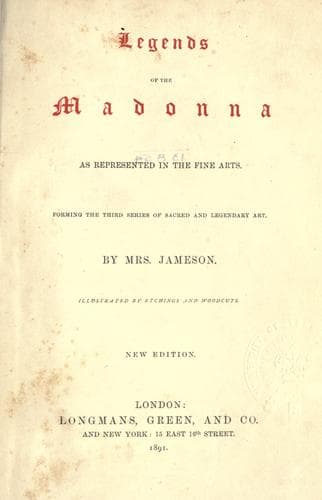
Legends of the Madonna as Represented in the Fine ArtsJameson, Mrs. (Anna)
Religion
Legends of the Madonna as Represented in the Fine Arts
Jameson, Mrs. (Anna)
Christian saints in art; Mary, Blessed Virgin, Saint -- Art; Mary, Blessed Virgin, Saint -- Legends
Under the name of Anna, the Church has honoured, from remote times,
the memory of the mother of the Virgin. The Hebrew name, signifying
_Grace_, or _the Gracious_, and all the traditions concerning her,
came to us from the East, where she was so early venerated as a
saint, that a church was dedicated to her by the Emperor Justinian,
in 550. Several other churches were subsequently dedicated to her in
Constantinople during the sixth and seventh centuries, and her remains
are said to have been deposited there in 710. In the West, she first
became known in the reign of Charlemagne; and the Greek apocryphal
gospels, or at least stories and extracts from them, began to be
circulated about the same period. From these are derived the historic
scenes and legendary subjects relating to Joachim and Anna which
appear in early art. It was about 1500, in the beginning of the
sixteenth century, that the increasing veneration for the Virgin Mary
gave to her parents, more especially to St. Anna, increased celebrity
as patron saints; and they became, thenceforward, more frequent
characters in the sacred groups. The feast of St. Anna was already
general and popular throughout Europe long before it was rendered
obligatory in 1584.[1] The growing enthusiasm for the doctrine of
the Immaculate Conception gave, of course, additional splendour and
importance to her character. Still, it is only in later times that we
find the effigy of St. Anna separated from that of the Virgin. There
is a curious picture by Cesi (Bologna Gal.), in which St. Anna kneels
before a vision of her daughter before she is born--the Virgin of the
Immaculate Conception. A fine model of a bearded man was now sometimes
converted into a St. Joachim reading or meditating, instead of a
St. Peter or a St. Jerome, as heretofore. In the Munich Gallery are
two fine ancient-looking figures of St. Joachim the father, and St.
Joseph the husband, of the Virgin, standing together; but all these
as separate representations, are very uncommon; and, of those which
exhibit St. Anna devotionally, as enthroned with the Virgin and Child,
I have already spoken. Like St. Elizabeth, she should be an elderly,
but not a _very_ old woman. Joachim, in such pictures, never appears
but as an attendant saint, and then very rarely; always very old, and
sometimes in the dress of a priest, which however, is a mistake on the
part of the artist.
[Footnote 1: In England we have twenty-eight churches dedicated in the
name of St. Anna.]
* * * * *
A complete series of the history of the Blessed Virgin, as imaged
forth by the early artists, always begins with the legend of Joachim
and Anna, which is thus related.
Public-domain text, read in full here on John Shaqi.
Reviews
Reviews
No reviews yet
Be the first to share your thoughts on this work.
Elsewhere in the archive
Join the Discussion
Join the discussion
Sign in to leave a comment or review.
Sign InorCreate an account