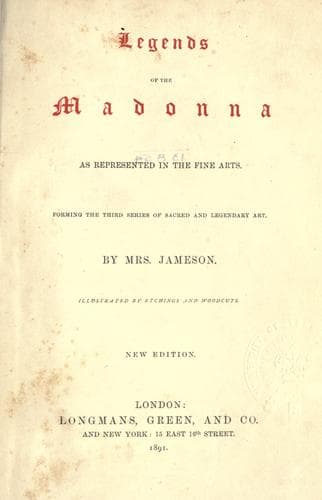
Legends of the Madonna as Represented in the Fine ArtsJameson, Mrs. (Anna)
Religion
Legends of the Madonna as Represented in the Fine Arts
Jameson, Mrs. (Anna)
Christian saints in art; Mary, Blessed Virgin, Saint -- Art; Mary, Blessed Virgin, Saint -- Legends
But to the scenes narrated in the Gospels the painters did not confine
themselves. Not only were the simple scripture histories coloured
throughout by the predominant and enthusiastic veneration paid to the
Virgin--till the life of Christ was absolutely merged in that of His
mother, and its various incidents became "the seven joys and the seven
sorrows of Mary,"--but we find the artistic representations of her
life curiously embroidered and variegated by the introduction of
traditional and apocryphal circumstances, in most cases sanctioned
by the Church authorities of the time. However doubtful or repulsive
some of these scenes and incidents, we cannot call them absolutely
unmeaning or absurd; on the contrary, what was _supposed_ grew up very
naturally, in the vivid and excited imaginations of the people, out of
what was _recorded_; nor did they distinguish accurately between what
they were allowed and what they were commanded to believe. Neither can
it be denied that the traditional incidents--those at least which we
find artistically treated--are often singularly beautiful, poetical,
and instructive. In the hands of the great religions artists, who
worked in their vocation with faith and simplicity, objects and scenes
the most familiar and commonplace became sanctified and glorified by
association with what we deem most holy and most venerable. In the
hands of the later painters the result was just the reverse--what
was most spiritual, most hallowed, most elevated, became secularized,
materialized, and shockingly degraded.
No subject has been more profoundly felt and more beautifully handled
by the old painters, nor more vilely mishandled by the moderns, than
the ANNUNCIATION, of all the scenes in the life of Mary the most
important and the most commonly met with. Considered merely as an
artistic subject, it is surely eminently beautiful: it places before
us the two most graceful forms which the hand of man was ever called
on to delineate;--the winged spirit fresh from paradise; the woman
not less pure, and even more highly blessed--the chosen vessel of
redemption, and the personification of all female loveliness, all
female excellence, all wisdom, and all purity.
* * * * *
We find the Annunciation, like many other scriptural incidents,
treated in two ways--as a mystery, and as an event. Taken in the
former sense, it became the expressive symbol of a momentous article
of faith, _The Incarnation of the Deity_. Taken in the latter sense,
it represented the announcement of salvation to mankind, through the
direct interposition of miraculous power. In one sense or the other,
it enters into every scheme of ecclesiastical decoration; but
chiefly it is set before us as a great and awful mystery, of which
the two figures of Gabriel, the angel-messenger, and Mary the
"highly-favoured," placed in relation to each other, became the
universally accepted symbol, rather than the representation.
Public-domain text, read in full here on John Shaqi.
Reviews
Reviews
No reviews yet
Be the first to share your thoughts on this work.
Elsewhere in the archive
Join the Discussion
Join the discussion
Sign in to leave a comment or review.
Sign InorCreate an account