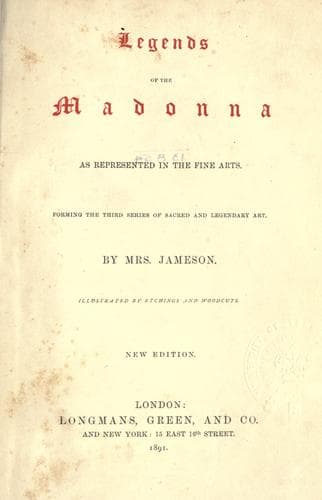
Legends of the Madonna as Represented in the Fine ArtsJameson, Mrs. (Anna)
Religion
Legends of the Madonna as Represented in the Fine Arts
Jameson, Mrs. (Anna)
Christian saints in art; Mary, Blessed Virgin, Saint -- Art; Mary, Blessed Virgin, Saint -- Legends
THE ANNUNCIATION AS A MYSTERY.
Considering the importance given to the Annunciation in its mystical
sense, it is strange that we do not find it among the very ancient
symbolical subjects adopted in the first ages of Christian art. It
does not appear on the sarcophagi, nor in the early Greek carvings and
diptychs, nor in the early mosaics--except once, and then as a part of
the history of Christ, not as a symbol; nor can we trace the mystical
treatment of this subject higher than the eleventh century, when
it first appears in the Gothic sculpture and stained glass. In the
thirteenth, and thenceforward, the Annunciation appears before
us, as the expression in form of a theological dogma, everywhere
conspicuous. It became a primal element in every combination of sacred
representations; the corner-stone, as it were, of every architectural
system of religious decoration. It formed a part of every altar-piece,
either in sculpture or painting. Sometimes the Virgin stands on
one side of the altar, the angel on the other, carved in marble or
alabaster, or of wood richly painted and gilt; or even, as I have
seen in some instances, of solid silver. Not seldom, we find the two
figures placed in niches against the pillars, or on pedestals at the
entrance of the choir. It was not necessary, when thus symbolically
treated, to place the two figures in proximity to signify their
relation to each other; they are often divided by the whole breadth
of the chancel.
Whatever the subject of the altar-piece--whether the Nativity, or the
Enthroned Madonna, or the Coronation, or the Crucifixion, or the
Last Supper,--the Annunciation almost invariably formed part of the
decoration, inserted either into the spandrels of the arches above, or
in the predella below; or, which is very common, painted or carved on
the doors of a tabernacle or triptychon.
If the figures are full-length, a certain symmetry being required,
they are either both standing or both kneeling; it is only in later
times that the Virgin sits, and the angel kneels. When disposed in
circles or semicircles, they are often merely busts, or half-length
figures, separated perhaps by a framework of tracery, or set on each
side of the principal subject, whatever that may be. Hence it is
that we so often find in galleries and collections, pictures of the
Annunciation in two separate parts, the angel in one frame, the
Virgin in another; and perhaps the two pictures, thus disunited,
may have found their way into different countries and different
collections,--the Virgin being in Italy and the angel in England.
Public-domain text, read in full here on John Shaqi.
Reviews
Reviews
No reviews yet
Be the first to share your thoughts on this work.
Elsewhere in the archive
Join the Discussion
Join the discussion
Sign in to leave a comment or review.
Sign InorCreate an account