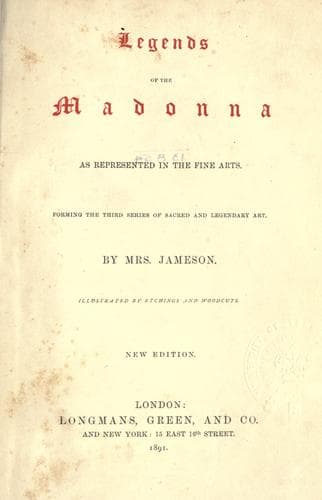
Legends of the Madonna as Represented in the Fine ArtsJameson, Mrs. (Anna)
Religion
Legends of the Madonna as Represented in the Fine Arts
Jameson, Mrs. (Anna)
Christian saints in art; Mary, Blessed Virgin, Saint -- Art; Mary, Blessed Virgin, Saint -- Legends
I must, however, notice one more picture. Of six Annunciations
painted by Rubens, five represent the event; the sixth is one of his
magnificent and most palpable allegories, all glowing with life and
reality. Here Mary kneels on the summit of a flight of steps; a dove,
encompassed by cherubim, hovers over her head. Before her kneels
the celestial messenger; behind him Moses and Aaron, with David and
other patriarchal ancestors of Christ. In the clouds above is seen
the heavenly Father; on his right are two female figures, Peace and
Reconciliation; on his left, angels bear the ark of the covenant. In
the lower part of the picture, stand Isaiah and Jeremiah, with four
sibyls:--thus connecting the prophecies of the Old Testament, and
the promises made to the Gentile nations through the sibyls, with the
fulfilment of both in the message from on high.
THE ANNUNCIATION AS AN EVENT.
Had the Annunciation to Mary been merely mentioned as an awful and
incomprehensible vision, it would have been better to have adhered to
the mystical style of treatment, or left it alone altogether; but the
Scripture history, by giving the whole narration as a simple fact, a
real event, left it free for representation as such; and, as such, the
fancy of the artist was to be controlled and limited only by the words
of Scripture as commonly understood and interpreted, and by those
proprieties of time, place, and circumstance, which would be required
in the representation of any other historical incident or action.
When all the accompaniments show that nothing more was in the mind
of the artist than the aim to exhibit an incident in the life of the
Virgin, or an introduction to that of our Lord, the representation is
no longer mystical and devotional, but historical. The story was to be
told with all the fidelity, or at least all the likelihood, that was
possible; and it is clear that, in this case, the subject admitted,
and even required, a more dramatic treatment, with such accessories
and accompaniments as might bring the scene within the sphere of the
actual. In this sense it is not to be mistaken. Although the action is
of itself so very simple, and the actors confined to two persons, it
is astonishing to note the infinite variations of which this favourite
theme has been found susceptible. Whether all these be equally
appropriate and laudable, is quite another question; and in how far
the painters have truly interpreted the Scriptural narration, is now
to be considered.
Public-domain text, read in full here on John Shaqi.
Reviews
Reviews
No reviews yet
Be the first to share your thoughts on this work.
Elsewhere in the archive
Join the Discussion
Join the discussion
Sign in to leave a comment or review.
Sign InorCreate an account