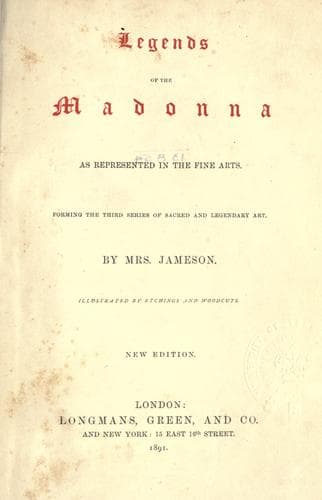
Legends of the Madonna as Represented in the Fine ArtsJameson, Mrs. (Anna)
Religion
Legends of the Madonna as Represented in the Fine Arts
Jameson, Mrs. (Anna)
Christian saints in art; Mary, Blessed Virgin, Saint -- Art; Mary, Blessed Virgin, Saint -- Legends
And first, with regard to the time, which is not especially mentioned.
It was presumed by the Fathers and early commentators on Scripture,
that the Annunciation must have taken place in early spring-time, at
eventide, soon after sunset, the hour since consecrated as the "Ave
Maria," as the bell which announces it is called the "Angelus;"[1]
but other authorities say that it was rather at midnight, because
the nativity of our Lord took place at the corresponding hour in the
following December. This we find exactly attended to by many of the
old painters, and indicated either by the moon and stars in the sky,
or by a taper or a lamp burning near.
[Footnote 1: So Lord Byron:--
"Ave Maria! blessed be the hour!
The time, the clime, the spot, where I so oft
Have felt that moment in its fullest power
Sink o'er the earth so beautiful and soft,
While swung the deep bell in the distant tower,
Or the faint dying day-hymn stole aloft,
And not a breath crept through the rosy air,
And yet the forest leaves seem'd stirr'd with prayer"]
* * * * *
With regard to the locality, we are told by St. Luke that the angel
Gabriel was sent from God, and that "he came _in_ to Mary" (Luke i.
28), which seems to express that she was _within_ her house.
In describing the actual scene of the interview between the angel and
Mary, the legendary story of the Virgin adheres very closely to the
scriptural text. But it also relates, that Mary went forth at evening
to draw water from the fountain; that she heard a voice which said,
"Hail thou that art full of grace!" and thereupon being troubled, she
looked to the right and to the left, and seeing no one, returned to
her _house_, and sat down to her work, (Protevangelion, ix. 7.) Had
any exact attention been paid to oriental customs, Mary might have
been working or reading or meditating on the roof of her house; but
this has not suggested itself in any instance that I can remember. We
have, as the scene of the interview, an interior which is sometimes
like an oratory, sometimes a portico with open arcades; but more
generally a bedroom. The poverty of Joseph and Mary, and their humble
condition in life, are sometimes attended to, but not always; for,
according to one tradition, the house at Nazareth was that which Mary
had inherited from her parents, Joachim and Anna, who were people of
substance. Hence, the painters had an excuse for making the chamber
richly furnished, the portico sustained by marble pillars, or
decorated with sculpture. In the German and Flemish pictures, the
artist, true to the national characteristic of _naïve_ and literal
illustration, gives us a German or a Gothic chamber, with a lattice
window of small panes of glass, and a couch with pillows, or a
comfortable four-post bedstead, furnished with draperies, thus
imparting to the whole scene an air of the most vivid homely reality.
Public-domain text, read in full here on John Shaqi.
Reviews
Reviews
No reviews yet
Be the first to share your thoughts on this work.
Elsewhere in the archive
Join the Discussion
Join the discussion
Sign in to leave a comment or review.
Sign InorCreate an account