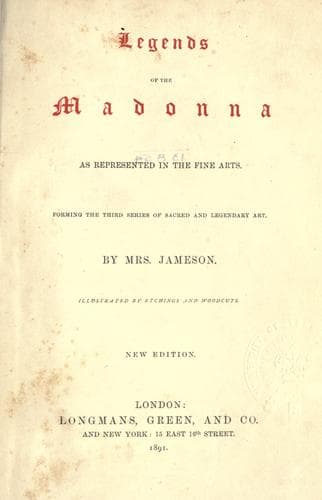
Legends of the Madonna as Represented in the Fine ArtsJameson, Mrs. (Anna)
Religion
Legends of the Madonna as Represented in the Fine Arts
Jameson, Mrs. (Anna)
Christian saints in art; Mary, Blessed Virgin, Saint -- Art; Mary, Blessed Virgin, Saint -- Legends
"The angel (who came down to earth
With tidings of the peace to many years
Wept for in vain, that op'd the heavenly gates
From their long interdict) before us seem'd
In a sweet act so sculptur'd to the life,
He look'd no silent image. One had sworn
He had said 'Hail!' for SHE was imag'd there,
By whom the key did open to God's love;
And in her act as sensibly imprest
That word, 'Behold the handmaid of the Lord,'
As figure seal'd on wax."
And very beautifully has Flaxman transferred the sculpture "divinely
wrought upon the rock of marble white" to earthly form.
* * * * *
The presence of the Holy Spirit in the historical Annunciations is to
be accounted for by the words of St. Luke, and the visible form of the
Dove is conventional and authorized. In many pictures, the celestial
Dove enters by the open casement. Sometimes it seems to brood
immediately over the head of the Virgin; sometimes it hovers towards
her bosom. As for the perpetual introduction of the emblem of the
Padre Eterno, seen above the sky, under the usual half-figure of a
kingly ancient man, surrounded by a glory of cherubim, and sending
forth upon a beam of light the immaculate Dove, there is nothing to
be said but the usual excuse for the mediæval artists, that certainly
there was no _conscious_ irreverence. The old painters, great as they
were in art, lived in ignorant but zealous times--in times when
faith was so fixed, so much a part of the life and soul, that it was
not easily shocked or shaken; as it was not founded in knowledge or
reason, so nothing that startled the reason could impair it. Religion,
which now speaks to us through words, then spoke to the people through
visible forms universally accepted; and, in the fine arts, we accept
such forms according to the feeling which _then_ existed in men's
minds, and which, in its sincerity, demands our respect, though now we
might not, could not, tolerate the repetition. We must also remember
that it was not in the ages of ignorance and faith that we find
the grossest materialism in art. It was in the learned, half-pagan
sixteenth and the polished seventeenth century, that this materialized
theology became most offensive. Of all the artists who have sinned
in the Annunciation--and they are many--Nicolò Poussin is perhaps
the worst. Yet he was a good, a pious man, as well as a learned and
accomplished painter. All through the history of the art, the French
show themselves as the most signal violators of good taste, and what
they have invented a word for--_bienséance_. They are worse than the
old Germans; worse than the modern Spaniards--and that is saying much.
In Raphael's Annunciation, Mary is seated in a reclining attitude,
leaning against the side of her couch, and holding a book. The angel,
whose attitude expresses a graceful _empressement_, kneels at some
distance, holding the lily.
* * * * *
Public-domain text, read in full here on John Shaqi.
Reviews
Reviews
No reviews yet
Be the first to share your thoughts on this work.
Elsewhere in the archive
Join the Discussion
Join the discussion
Sign in to leave a comment or review.
Sign InorCreate an account