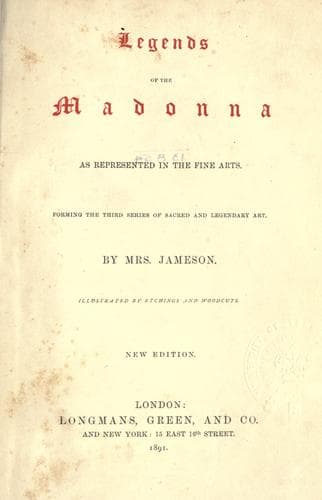
Legends of the Madonna as Represented in the Fine ArtsJameson, Mrs. (Anna)
Religion
Legends of the Madonna as Represented in the Fine Arts
Jameson, Mrs. (Anna)
Christian saints in art; Mary, Blessed Virgin, Saint -- Art; Mary, Blessed Virgin, Saint -- Legends
Michael Angelo gives us a most majestic Virgin standing on the steps
of a prie-Dieu, and turning with hands upraised towards the angel, who
appears to have entered by the open door; his figure is most clumsy
and material, and his attitude unmeaning and ungraceful. It is, I
think, the only instance in which Michael Angelo has given wings to
an angelic being: for here they could not be dispensed with.
In a beautiful Annunciation by Johan Van Eyck (Munich Gal., Cabinet
iii. 35), the Virgin kneels at a desk with a book before her. She has
long fair hair, and a noble intellectual brow. Gabriel, holding his
sceptre, stands in the door-way. The Dove enters by the lattice. A
bed is in the background, and in front a pot of lilies. In another
Annunciation by Van Eyck, painted on the Ghent altar-piece, we have
the mystic, not the historical, representation, and a very beautiful
effect is produced by clothing both the angel and Mary in robes of
pure white. (Berlin Gal., 520, 521.)
In an engraving after Rembrandt, the Virgin kneels by a fountain,
and the angel kneels on the opposite side. This seems to express the
legendary scene.
These few observations on the general arrangement of the theme,
whether mystical or historical, will, I hope, assist the observer in
discriminating for himself. I must not venture further, for we have a
wide range of subjects before us.
THE VISITATION.
_Ital._ La Visitazione di Maria. _Fr._ La Visitation de la Vierge
_Ger._ Die Heimsuchung Mariä. July 2.
After the Annunciation of the angel, the Scripture goes on to relate
how "Mary arose and went up into the hill country with haste, to
the house of her cousin Elizabeth, and saluted her." This meeting
of the two kinswomen is the subject styled in art the "Visitation,"
and sometimes the "Salutation of Elizabeth." It is of considerable
importance, in a series of the life of the Virgin, as an event; and
also, when taken separately in its religious significance, as being
the first recognition of the character of the Messiah. "Whence is this
to me," exclaims Elizabeth, "that the mother of my Lord should come to
me?" (Luke i. 43); and as she spoke this through the influence of the
Holy Spirit, and not through knowledge, she is considered in the light
of a prophetess.
Public-domain text, read in full here on John Shaqi.
Reviews
Reviews
No reviews yet
Be the first to share your thoughts on this work.
Elsewhere in the archive
Join the Discussion
Join the discussion
Sign in to leave a comment or review.
Sign InorCreate an account