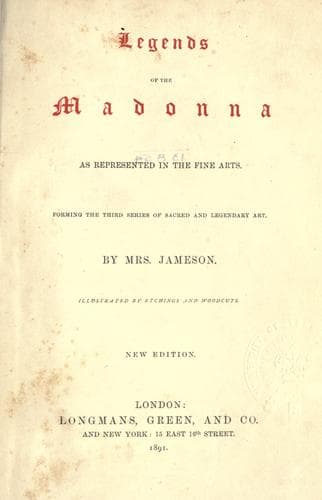
Legends of the Madonna as Represented in the Fine ArtsJameson, Mrs. (Anna)
Religion
Legends of the Madonna as Represented in the Fine Arts
Jameson, Mrs. (Anna)
Christian saints in art; Mary, Blessed Virgin, Saint -- Art; Mary, Blessed Virgin, Saint -- Legends
The sibylline prophecy is supposed to have occurred a short tune
before the Nativity, about the same period when the decree went forth
"that all the world should be taxed." Joseph, therefore, arose and
saddled his ass, and set his wife upon it, and went up from Nazareth
to Bethlehem. The way was long, and steep, and weary; "and when Joseph
looked back, he saw the face of Mary that it was sorrowful, as of one
in pain; but when he looked back again, she smiled. And when they,
were come to Bethlehem, there was no room for them in the inn, because
of the great concourse of people. And Mary said to Joseph, "Take me
down for I suffer." (Protevangelion.)
The journey to Bethlehem, and the grief and perplexity of Joseph, have
been often represented. 1. There exists a very ancient Greek carving
in ivory, wherein Mary is seated on the ass, with an expression of
suffering, and Joseph tenderly sustains her; she has one arm round his
neck, leaning on him: an angel leads the ass, lighting the way with
a torch. It is supposed that this curious relic formed part of the
ornaments of the ivory throne of the Exarch of Ravenna, and that it is
at least as old as the sixth century.[1] 2. There is an instance more
dramatic in an engraving after a master of the seventeenth century.
Mary, seated on the ass, and holding the bridle, raises her eyes to
heaven with an expression of resignation; Joseph, cap in hand, humbly
expostulates with the master of the inn, who points towards the
stable; the innkeeper's wife looks up at the Virgin with a strong
expression of pity and sympathy. 3. I remember another print of the
same subject, where, in the background, angels are seen preparing the
cradle in a cave.
[Footnote 1: It is engraved in Gori's "Thesaurus," and described in
Münter's "Sinnbilder."]
I may as well add that the Virgin, in this character of mysterious,
and religious, and most pure maternity, is venerated under the title
of _La Madonna del Parto_.[1]
Public-domain text, read in full here on John Shaqi.
Reviews
Reviews
No reviews yet
Be the first to share your thoughts on this work.
Elsewhere in the archive
Join the Discussion
Join the discussion
Sign in to leave a comment or review.
Sign InorCreate an account