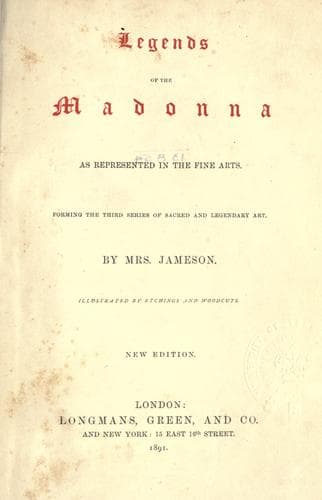
Legends of the Madonna as Represented in the Fine ArtsJameson, Mrs. (Anna)
Religion
Legends of the Madonna as Represented in the Fine Arts
Jameson, Mrs. (Anna)
Christian saints in art; Mary, Blessed Virgin, Saint -- Art; Mary, Blessed Virgin, Saint -- Legends
[Footnote 1: Every one who has visited Naples will remember the
church on the Mergellina, dedicated to the _Madonna del Parto_, where
lies, beneath his pagan tomb, the poet Sannazzaro. Mr. Hallam, in
a beautiful passage of his "History of the Literature of Europe,"
has pointed out the influence of the genius of Tasso on the whole
school of Bolognese painters of that time. Not less striking was the
influence of Sannazzaro and his famous poem on the Nativity (_De Partû
Virginis_), on the contemporary productions of Italian art, and more
particularly as regards the subject under consideration: I can trace
it through all the schools of art, from Milan to Naples, during the
latter half of the sixteenth century. Of Sannazzaro's poem, Mr.
Hallam says, that "it would be difficult to find its equal for purity,
elegance, and harmony of versification." It is not the less true, that
even its greatest merits as a Latin poem exercised the most perverse
influence on the religious art of that period. It was, indeed, only
_one_ of the many influences which may be said to have demoralized the
artists of the sixteenth century, but it was one of the greatest.]
The Nativity of our Saviour, like the Annunciation, has been treated
in two ways, as a mystery and as an event, and we must be careful to
discriminate between them.
THE NATIVITY AS A MYSTERY.
In the first sense the artist has intended simply to express the
advent of the Divinity on earth in the form of an Infant, and the
_motif_ is clearly taken from a text in the Office of the Virgin,
_Virgo quem genuit, adoravit._ In the beautiful words of Jeremy
Taylor, "She blessed him, she worshipped him, and she thanked him that
he would be born of her;" as, indeed, many a young mother has done
before and since, when she has hung in adoration over the cradle of
her first-born child;--but _here_ the child was to be a descended
God; and nothing, as it seems to me, can be more graceful and more
profoundly suggestive than the manner in which some of the early
Italian artists have expressed this idea. When, in such pictures, the
locality is marked by the poor stable, or the rough rocky cave, it
becomes "a temple full of religion, full of glory, where angels are
the ministers, the holy Virgin the worshipper, and Christ the Deity."
Very few accessories are admitted, merely such as serve to denote that
the subject is "a Nativity," properly so called, and not the "Madre
Pia," as already described. The divine Infant lies in the centre of
the picture, sometimes on a white napkin, sometimes with no other
bed than the flowery turf; sometimes his head rests on a wheat-sheaf,
always here interpreted as "the bread of life." He places his finger
on his lip, which expresses the _Verbum sum_ (or, _Vere Verbum hoc
est abbreviatum_), "I am the word," or "I am the bread of life" (_Ego
sum panis ille vitæ._ John vi. 48), and fixes his eyes on the heavens
above, where the angels are singing the _Gloria in excelsis._ In
Public-domain text, read in full here on John Shaqi.
Reviews
Reviews
No reviews yet
Be the first to share your thoughts on this work.
Elsewhere in the archive
Join the Discussion
Join the discussion
Sign in to leave a comment or review.
Sign InorCreate an account