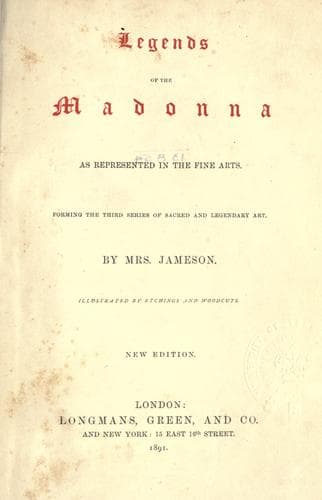
Legends of the Madonna as Represented in the Fine ArtsJameson, Mrs. (Anna)
Religion
Legends of the Madonna as Represented in the Fine Arts
Jameson, Mrs. (Anna)
Christian saints in art; Mary, Blessed Virgin, Saint -- Art; Mary, Blessed Virgin, Saint -- Legends
one instance, I remember, an angel holds up the cross before him; in
another, he grasps it in his hand; or it is a nail, or the crown of
thorns, anticipative of his earthly destiny. The Virgin kneels on one
side; St. Joseph, when introduced, kneels on the other; and frequently
angels unite with them in the act of adoration, or sustain the
new-born Child. In this poetical version of the subject, Lorenzo
di Credi, Perugino, Francia, and Bellini, excelled all others[1].
Lorenzo, in particular, became quite renowned for the manner in which
he treated it, and a number of beautiful compositions from his hand
exist in the Florentine and other galleries.
[Footnote 1: There are also most charming examples in sculpture by
Luca della Robbia, Donatello, and other masters of the Florentine
school.]
There are instances in which attendant saints and votaries are
introduced as beholding and adoring this great mystery. 1. For
instance, in a picture by Cima, Tobit and the angel are introduced
on one side, and St. Helena and St. Catherine on the other. 2. In a
picture by Francia (Bologna Gal.), the Infant, reclining upon a white
napkin, is adored by the kneeling Virgin, by St. Augustine, and by two
angels also kneeling. The votary, Antonio Galeazzo Bentivoglio, for
whom the picture was painted, kneels in the habit of a pilgrim.[1] He
had lately returned from a pilgrimage to Jerusalem and Bethlehem, thus
poetically expressed in the scene of the Nativity, and the picture was
dedicated as an act of thanksgiving as well as of faith. St. Joseph
and St. Francis stand on one side; on the other is a shepherd crowned
with laurel. Francia, according to tradition, painted his own portrait
as St. Francis; and his friend the poet, Girolamo Casio de' Medici,
as the shepherd. 3. In a large and famous Nativity by Giulio Romano
(Louvre, 293), which once belonged to our Charles I., St. John the
Evangelist, and St. Longinus (who pierced our Saviour's side with his
lance), are standing on each side as two witnesses to the divinity of
Christ;--here strangely enough placed on a par: but we are reminded
that Longinus had lately been inaugurated as patron of Mantua, (v.
Sacred and Legendary Art.)
[Footnote 1: "An excellent likeness," says Vasari. It is engraved as
such in Litta's Memorials of the Bentivogli. Girolamo Casio received
the laurel crown from the hand of Clement VII. in 1523. A beautiful
votive Madonna, dedicated by Girolamo Casio and his son Giacomo, and
painted by Beltraffio, is in the Louvre.]
In a triptych by Hans Hemling (Berlin Gal.) we have in the centre the
Child, adored, as usual, by the Virgin mother and attending angels,
the votary also kneeling: in the compartment on the right, we find the
manifestation of the Redeemer to the _west_ exhibited in the prophecy
of the sibyl to Augustus; on the left, the manifestation of the
Redeemer to the _east_ is expressed by the journey of the Magi, and
the miraculous star--"we have seen his star _in the east_."
Public-domain text, read in full here on John Shaqi.
Reviews
Reviews
No reviews yet
Be the first to share your thoughts on this work.
Elsewhere in the archive
Join the Discussion
Join the discussion
Sign in to leave a comment or review.
Sign InorCreate an account