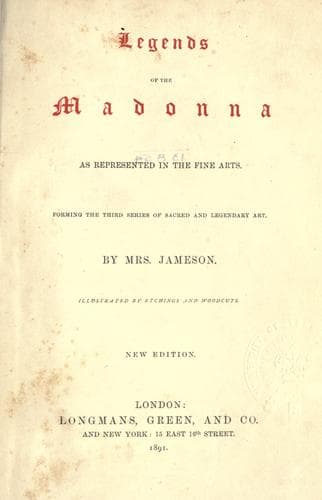
Legends of the Madonna as Represented in the Fine ArtsJameson, Mrs. (Anna)
Religion
Legends of the Madonna as Represented in the Fine Arts
Jameson, Mrs. (Anna)
Christian saints in art; Mary, Blessed Virgin, Saint -- Art; Mary, Blessed Virgin, Saint -- Legends
There is, in the collection of Lord Shrewsbury, at Alton Towers, a
Riposo attributed to Giorgione, remarkable equally for the beauty and
the singularity of the treatment. The Holy Family are seated in the
midst of a wild but rich landscape, quite in the Venetian style;
Joseph is asleep; the two children are playing with a lamb. The
Virgin, seated holds a book, and turns round, with an expression of
surprise and alarm, to a female figure who stands on the right. This
woman has a dark physiognomy, ample flowing drapery of red and white,
a white turban twisted round her head, and stretches out her hand with
the air of a sibyl. The explanation of this striking group I found
in an old ballad-legend. Every one who has studied the moral as well
as the technical character of the various schools of art, must have
remarked how often the Venetians (and Giorgione more especially)
painted groups from the popular fictions and ballads of the time; and
it has often been regretted that many of these pictures are becoming
unintelligible to us from our having lost the key to them, in losing
all trace of the fugitive poems or tales which suggested them.
The religious ballad I allude to must have been popular in the
sixteenth century; it exists in the Provençal dialect, in German,
and in Italian; and, like the wild ballad of St. John Chrysostom, it
probably came in some form or other from the East. The theme is, in
all these versions, substantially the same. The Virgin, on her arrival
in Egypt, is encountered by a gypsy (Zingara or Zingarella), who
crosses the Child's palm after the gypsy manner, and foretells all the
wonderful and terrible things which, as the Redeemer of mankind, he
was destined to perform and endure on earth.
An Italian version which lies before me is entitled, _Canzonetta
nuova, sopra la Madonna, quando si partò in Egitto col Bambino Gesù
e San Giuseppe_, "A new Ballad of our Lady, when she fled into Egypt
with the Child Jesus and St. Joseph."
It begins with a conversation between the Virgin, who has just arrived
from her long journey, and the gypsy-woman, who thus salutes her:--
ZINGARELLA.
Dio ti salvi, bella Signora,
E ti dia buona ventura.
Ben venuto, vecchiarello,
Con questo bambino bello!
MADONNA.
Ben trovata, sorella mia,
La sua grazia Dio ti dia.
Ti perdoni i tuoi peccati
L' infinità sua bontade.
ZINGARELLA.
Siete stanchi e meschini,
Credo, poveri pellegrini
Che cercate d' alloggiare.
Vuoi, Signora, scavalcare?
MADONNA.
Voi che siete, sorella mia,
Tutta piena di cortesia,
Dio vi renda la carità
Per l'infinità sua bontà.
Noi veniam da Nazaretta,
Siamo senza alcun ricetto,
Arrivati all' strania
Stanchi e lassi dalla via!
GYPSY.
God save thee, fair Lady, and give thee good luck
Welcome, good old man, with this thy fair Child!
MARY.
Well met, sister mine! God give thee grace, and of
his infinite mercy forgive thee thy sins!
Public-domain text, read in full here on John Shaqi.
Reviews
Reviews
No reviews yet
Be the first to share your thoughts on this work.
Elsewhere in the archive
Join the Discussion
Join the discussion
Sign in to leave a comment or review.
Sign InorCreate an account