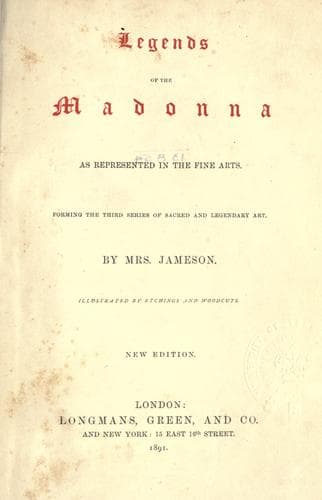
Legends of the Madonna as Represented in the Fine ArtsJameson, Mrs. (Anna)
Religion
Legends of the Madonna as Represented in the Fine Arts
Jameson, Mrs. (Anna)
Christian saints in art; Mary, Blessed Virgin, Saint -- Art; Mary, Blessed Virgin, Saint -- Legends
GYPSY.
Ye are tired and drooping, poor pilgrims, as I think,
seeking a night's lodging. Lady, wilt thou choose to alight?
MARY.
O sister mine! full of courtesy, God of his infinite goodness
reward thee for thy charity. We are come from
Nazareth, and we are without a place to lay our heads,
arrived in a strange land, all tired and weary with the way!
The Zingarella then offers them a resting-place, and straw and fodder
for the ass, which being accepted, she asks leave to tell their
fortune, but begins by recounting, in about thirty stanzas, all the
past history of the Virgin pilgrim; she then asks to see the Child--
Ora tu, Signora mia.
Che sei piena di cortesia,
Mostramelo per favore
Lo tuo Figlio Redentore!
And now, O Lady mine, that art full of courtesy, grant
me to look upon thy Son, the Redeemer!
The Virgin takes him from the arms of Joseph--
Datemi, o caro sposo,
Lo mio Figlio grazioso!
Quando il vide sta meschina
Zingarella, che indovina!
Give me, dear husband, my lovely boy, that this poor
gypsy, who is a prophetess, may look upon him.
The gypsy responds with becoming admiration and humility, praises
the beauty of the Child, and then proceeds to examine his palm: which
having done, she breaks forth into a prophecy of all the awful future,
tells how he would be baptized, and tempted, scourged, and finally
hung upon a cross--
Questo Figlio accarezzato
Tu lo vedrai ammazzato
Sopra d'una dura croce,
Figlio bello! Figlio dolce!
but consoles the disconsolate Mother, doomed to honour for the sake of
us sinners--
Sei arrivata a tanti onori
Per noi altri Peccatori!
and ends by begging an alms--
Non ti vo' più infastidire,
Bella Signora; so chi hai a fare.
Dona la limosinella
A sta povera Zingarella
true repentance and eternal life.
Vo' una vera contrizione
Per la tua intercezione,
Accio st' alma dopo morte
Tragga alle celesti porte!
And so the story ends.
There can be no doubt, I think, that we have here the original theme
of Giorgione's picture, and perhaps of others.
In the Provençal ballad, there are three gypsies, men, not women,
introduced, who tell the fortune of the Virgin and Joseph, as well
as that of the Child, and end by begging alms "to wet their thirsty
throats." Of this version there is a very spirited and characteristic
translation by Mr. Kenyon, under the title of "a Gypsy Carol."[1]
[Footnote 1: A Day at Tivoli, with other Verses, by John Kenyon, p.
149.]
THE RETURN FROM EGYPT.
According to some authorities, the Holy Family sojourned in Egypt
during a period of seven years, but others assert that they returned
to Judea at the end of two years.
Public-domain text, read in full here on John Shaqi.
Reviews
Reviews
No reviews yet
Be the first to share your thoughts on this work.
Elsewhere in the archive
Join the Discussion
Join the discussion
Sign in to leave a comment or review.
Sign InorCreate an account