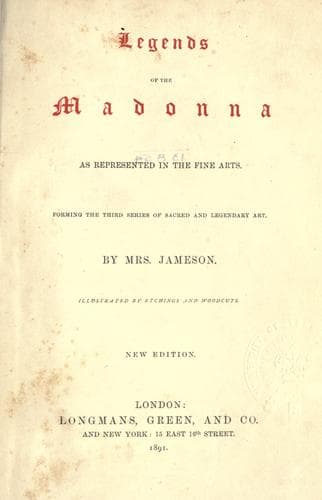
Legends of the Madonna as Represented in the Fine ArtsJameson, Mrs. (Anna)
Religion
Legends of the Madonna as Represented in the Fine Arts
Jameson, Mrs. (Anna)
Christian saints in art; Mary, Blessed Virgin, Saint -- Art; Mary, Blessed Virgin, Saint -- Legends
These groups, so numerous, and of such perpetual recurrence, that they
alone form a large proportion of the contents of picture galleries
and the ornaments of churches, are, after all, a modern innovation in
sacred art. What may be called the _domestic_ treatment of the history
of the Virgin cannot be traced farther back than the middle of the
fifteenth century. It is, indeed, common to class all those pictures
as Holy Families which include any of the relatives of Christ grouped
with the Mother and her Child; but I must here recapitulate and
insist upon the distinction to be drawn between the _domestic_ and
the _devotional_ treatment of the subject; a distinction I have been
careful to keep in view throughout the whole range of sacred art,
and which, in this particular subject, depends on a difference in
sentiment and intention, more easily felt than set down in words. It
is, I must repeat, a _devotional_ group where the sacred personages
are placed in direct relation to the worshippers, and where their
supernatural character is paramount to every other. It is a _domestic_
or an _historical_ group, a Holy Family properly so called, when the
personages are placed in direct relation to each other by some link
of action or sentiment, which expresses the family connection between
them, or by some action which has a dramatic rather than a religious
significance. The Italians draw this distinction in the title "_Sacra
Conversazione_" given to the first-named subject, and that of "_Sacra
Famiglia_" given to the last. For instance, if the Virgin, watching
her sleeping Child, puts her finger on her lip to silence the little
St. John; there is here no relation between the spectator and the
persons represented, except that of unbidden sympathy: it is a
family group; a domestic scene. But if St. John, looking out of the
picture, points to the Infant, "Behold the Lamb of God!" then the
whole representation changes its significance; St. John assumes the
character of precursor, and we, the spectators, are directly addressed
and called upon to acknowledge the "Son of God, the Saviour of
mankind."
If St. Joseph, kneeling, presents flowers to the Infant Christ, while
Mary looks on tenderly (as in a group by Raphael), it is an act of
homage which expresses the mutual relation of the three personages; it
is a Holy Family: whereas, in the picture by Murillo, in our National
Gallery, where Joseph and Mary present the young Redeemer to the
homage of the spectator, while the form of the PADRE ETERNO, and
the Holy Spirit, with attendant angels, are floating above, we have
a devotional group, a "_Sacra Conversazione_:"--it is, in fact a
material representation of the Trinity; and the introduction of Joseph
into such immediate propinquity with the personages acknowledged
as divine is one of the characteristics of the later schools of
theological art. It could not possibly have occurred before the end
of the sixteenth or the beginning of the seventeenth century.
Public-domain text, read in full here on John Shaqi.
Reviews
Reviews
No reviews yet
Be the first to share your thoughts on this work.
Elsewhere in the archive
Join the Discussion
Join the discussion
Sign in to leave a comment or review.
Sign InorCreate an account