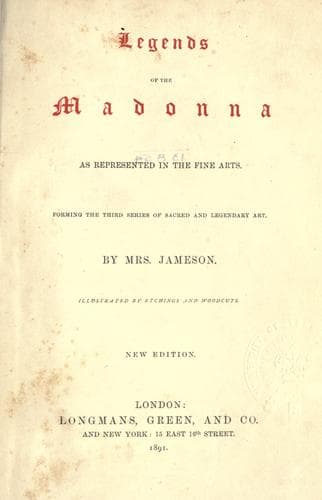
Legends of the Madonna as Represented in the Fine ArtsJameson, Mrs. (Anna)
Religion
Legends of the Madonna as Represented in the Fine Arts
Jameson, Mrs. (Anna)
Christian saints in art; Mary, Blessed Virgin, Saint -- Art; Mary, Blessed Virgin, Saint -- Legends
The introduction of persons who could not have been contemporary, as
St. Francis or St. Catherine, renders the group ideal and devotional.
On the other hand, as I have already observed, the introduction of
attendant angels does not place the subject out of the domain of the
actual; for the painters literally rendered what in the Scripture text
is distinctly set down and literally interpreted, "He shall give his
angels charge concerning thee." Wherever lived and moved the Infant
Godhead, angels were always _supposed_ to be present; therefore it lay
within the province of an art addressed especially to our senses, to
place them bodily before us, and to give to these heavenly attendants
a visible shape and bearing worthy of their blessed ministry.
The devotional groups, of which I have already treated most fully,
even while placed by the accessories quite beyond the range of actual
life, have been too often vulgarized and formalized by a trivial or
merely conventional treatment.[1] In these really domestic scenes,
where the painter sought unreproved his models in simple nature, and
trusted for his effect to what was holiest and most immutable in our
common humanity, he must have been a bungler indeed if he did not
succeed in touching some responsive chord of sympathy in the bosom of
the observer. This is, perhaps, the secret of the universal, and, in
general, deserved popularity of these Holy Families.
[Footnote 1: See the "Mater Amabilis" and the "Pastoral Madonnas," p.
229, 239.]
TWO FIGURES.
The simplest form of the family group is confined to two figures,
and expresses merely the relation between the Mother and the Child.
The _motif_ is precisely the same as in the formal, goddess-like,
enthroned Madonnas of the antique time; but here quite otherwise
worked out, and appealing to other sympathies. In the first instance,
the intention was to assert the contested pretensions of the human
mother to divine honours; here it was rather to assert the humanity of
her divine Son; and we have before us, in the simplest form, the first
and holiest of all the social relations.
Public-domain text, read in full here on John Shaqi.
Reviews
Reviews
No reviews yet
Be the first to share your thoughts on this work.
Elsewhere in the archive
Join the Discussion
Join the discussion
Sign in to leave a comment or review.
Sign InorCreate an account