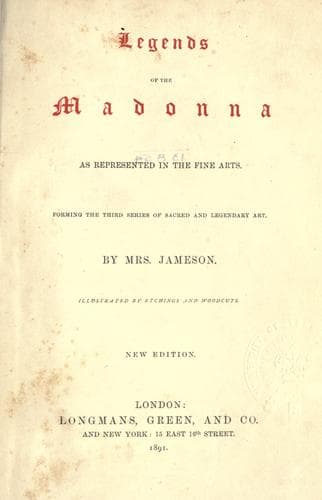
Legends of the Madonna as Represented in the Fine ArtsJameson, Mrs. (Anna)
Religion
Legends of the Madonna as Represented in the Fine Arts
Jameson, Mrs. (Anna)
Christian saints in art; Mary, Blessed Virgin, Saint -- Art; Mary, Blessed Virgin, Saint -- Legends
her tenderly, and showed her the wounds he had received for sinful
man. Then he bid her be comforted and weep no more, for the pain
of death had passed away, and the gates of hell had not prevailed
against him. And she thanked him meekly on her knees, for that he had
been pleased to bring redemption to man, and to make her the humble
instrument of his great mercy. And they sat and talked together, until
he took leave of her to return to the garden, and to show himself to
Mary Magdalene, who, next to his glorious Mother, had most need of
consolation.[3]
[Footnote 1:
"Regina Coeli lætare Alleluia!
Quia quem meruisti portare, Alleluia!
Resurrexit sicut dixit, Alleluia!
Ora pro nobis Deum, Alleluia!"]
[Footnote 2: The legend of the "Descent into Hades" (or limbo), often
treated of in art, will be given at length in the History of our
Lord.]
[Footnote 3: I have given the legend from various sources; but there
is something quite untranslatable and perfectly beautiful in the
naïveté of the old Italian version. After describing the celestial
music of the angels, the rejoicing of the liberated patriarchs, and
the appearance of Christ, _allegro, e bello e tutto lucido_, it thus
proceeds: "_Quando ella lo vidde, gli andò incontro ella ancora con
le braccia aperte, e quasi tramortita per l'allegrazza. Il benedetto
Gesù l'abbraccio teneressimamente, ed ella glidesse; 'Ahi, figliuolo
mio cordialissimo, sei tu veramente il mio Gesù, ò pur m'inganna
l'affetto!' 'Io sono il tuo figliuolo, madre mia, dolcissima,' disse
il Signore: 'cessino hormai le tue lagrime, non fare ch'io ti veda
più di mala voglia, Già son finiti li tuoi e li miei travagli e dolori
insieme!' Erano rimase alcune lagrime negli occhi della Vergine....
e per la grande allegrezza non poteva proferire parola alcuna ...
ma quando al fine potè parlare, lo ringrazio per parte di tutto
il genere humano, per la redenzione, operata e fatta, per tutto
generalmente."--v. Il Perfetto Legendario_]
The pathetic sentiment, and all the supernatural and mystical
accompaniments of this beautiful myth of the early ages, have been
very inadequately rendered by the artists. It is always treated as a
plain matter-of-fact scene. The Virgin kneels; the Saviour, bearing
his standard, stands before her; and where the delivered patriarchs
are introduced, they are generally either Adam and Eve, the authors
of the fall or Abraham and David, the progenitors of Christ and the
Virgin. The patriarchs are omitted in the earliest instance I can
refer to, one of the carved panels of the stalls in the Cathedral of
Amiens: also in the composition by Albert Durer, not included in his
life of the Virgin, but forming one of the series of the Passion.
Guido has represented the scene in a very fine picture, wherein an
angel bears the standard of victory, and behind our Saviour are Adam
and Eve. (Dresden Gal.)
Public-domain text, read in full here on John Shaqi.
Reviews
Reviews
No reviews yet
Be the first to share your thoughts on this work.
Elsewhere in the archive
Join the Discussion
Join the discussion
Sign in to leave a comment or review.
Sign InorCreate an account