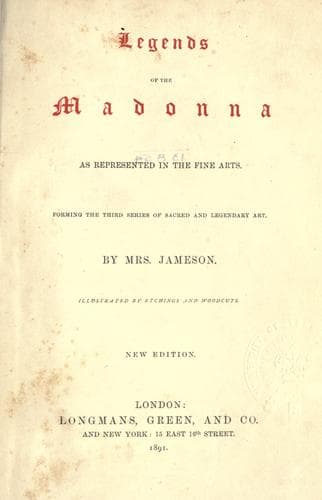
Legends of the Madonna as Represented in the Fine ArtsJameson, Mrs. (Anna)
Religion
Legends of the Madonna as Represented in the Fine Arts
Jameson, Mrs. (Anna)
Christian saints in art; Mary, Blessed Virgin, Saint -- Art; Mary, Blessed Virgin, Saint -- Legends
Another example, by Guercino (Cathedral, Cento), is cited by Goethe
as an instance of that excellence in the expression of the natural
and domestic affections which characterized the painter. Mary kneels
before her Son, looking up in his face with unutterable affection;
he regards her with a calm, sad look, "as if within his noble soul
there still remained the recollection of his sufferings and hers,
outliving the pang of death, the descent into the grave, and which
the resurrection had not yet dispelled." This, however, is not the
sentiment, at once affectionate and joyously triumphant, of the
old legend. I was pleased with a little picture in the Lichtenstein
Gallery at Vienna, where the risen Saviour, standing before his
Mother, points to the page of the book before her, as if he said, "See
you not that thus it is written?" (Luke xxiv. 46.) Behind Jesus is
St. John the Evangelist bearing the cup and the cross, as the cup of
sorrow and the cross of pain, not the mere emblems. There is another
example, by one of the Caracci, in the Fitzwilliam Collection at
Cambridge.
A picture by Albano of this subject, in which Christ comes flying or
floating on the air, like an incorporeal being, surrounded by little
fluttering cherubim, very much like Cupids, is an example of all that
is most false and objectionable in feeling and treatment. (Florence,
Pitti Pal.)
The popularity of this scene in the Bologna school of art arose, I
think, from its being adopted as one of the subjects from the Rosary,
the first of "the five Glorious Mysteries;" therefore especially
affected by the Dominicans, the great patrons of the Caracci at that
time.
* * * * *
The ASCENSION, though one of the "Glorious Mysteries," was also
accounted as the seventh and last of the sorrows of the Virgin, for
she was then left alone on earth. All the old legends represent her
as present on this occasion, and saying, as she followed with uplifted
eyes the soaring figure of Christ, "My Son, remember me when thou
comest to thy kingdom! Leave me not long after thee, my Son!" In
Giotto's composition in the chapel of the Arena, at Padua, she is by
far the most prominent figure. In almost all the late pictures of the
Ascension, she is introduced with the other Marys, kneeling on one
side, or placed in the centre among the apostles.
* * * * *
Public-domain text, read in full here on John Shaqi.
Reviews
Reviews
No reviews yet
Be the first to share your thoughts on this work.
Elsewhere in the archive
Join the Discussion
Join the discussion
Sign in to leave a comment or review.
Sign InorCreate an account