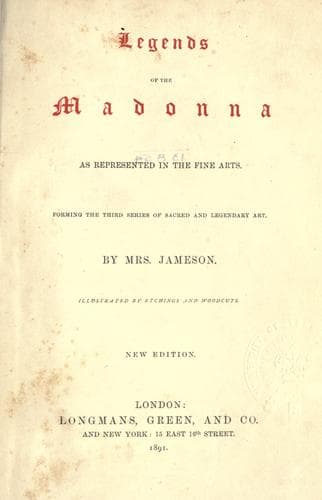
Legends of the Madonna as Represented in the Fine ArtsJameson, Mrs. (Anna)
Religion
Legends of the Madonna as Represented in the Fine Arts
Jameson, Mrs. (Anna)
Christian saints in art; Mary, Blessed Virgin, Saint -- Art; Mary, Blessed Virgin, Saint -- Legends
The DESCENT OF THE HOLY GHOST is a strictly scriptural subject. I
have heard it said that the introduction of Mary is not authorized by
the scripture narrative. I must observe, however that, without any
wringing of the text for an especial purpose, the passage might be
so interpreted. In the first chapter of the Acts (ver. 14), after
enumerating the apostles by name, it is added, "These all continued
with one accord in prayer and supplication, with the women and Mary
the mother of Jesus, and with his brethren." And in the commencement
of the second chapter the narrative thus proceeds: "And when the day
of Pentecost was fully come, they were _all_ with one accord in
one place." The word _all_ is, in the Concordance, referred to the
previous text (ver. 14), as including Mary and the women: thus they
who were constant in their love were not refused a participation in
the gifts of the Spirit. Mary, in her character of the divine Mother
of Wisdom, or even Wisdom herself,[1] did not, perhaps, need any
accession of intellectual light; but we must remember that the Holy
Spirit was the Comforter, as well as the Giver of wisdom; therefore,
equally needed by those, whether men or women, who were all equally
called upon to carry out the ministry of Christ in love and service,
in doing and in suffering.
[Footnote 1: The sublime eulogium of Wisdom (Prov. viii. 22), is, in
the Roman Catholic Church, applied to the Virgin Mary.]
In the account of the apostles I have already described at length the
various treatment and most celebrated examples of this subject, and
shall only make one or two observations with especial reference to
the figure of the Virgin. It was in accordance with the feelings and
convictions prevalent in the fifteenth century, that if Mary were
admitted to be present, she would take the principal place, as Queen
and Mother of the Apostles (_Regina et Mater Apostolorum_). She
is, therefore, usually placed either in front, or in the centre
on a raised seat or dais; and often holding a book (as the _Mater
Sapientiæ_); and she receives the divine affusion either with veiled
lids and meek rejoicing; or with uplifted eyes, as one inspired, she
pours forth the hymn, _Veni, Sancte Spiritus_.
I agree with the critics that, as the Spirit descended in form
of cloven tongues of fire, the emblem of the Dove, almost always
introduced, is here superfluous, and, indeed, out of place.
* * * * *
Public-domain text, read in full here on John Shaqi.
Reviews
Reviews
No reviews yet
Be the first to share your thoughts on this work.
Elsewhere in the archive
Join the Discussion
Join the discussion
Sign in to leave a comment or review.
Sign InorCreate an account