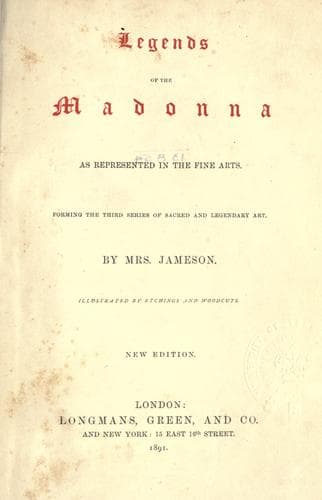
Legends of the Madonna as Represented in the Fine ArtsJameson, Mrs. (Anna)
Religion
Legends of the Madonna as Represented in the Fine Arts
Jameson, Mrs. (Anna)
Christian saints in art; Mary, Blessed Virgin, Saint -- Art; Mary, Blessed Virgin, Saint -- Legends
1. Early Florentine, about 1450. (Coll. of Fuller Maitland, Esq.)
The Virgin, seated, elegantly draped in white, and with pale-blue
ornaments in her hair, rises within a glory sustained by six angels;
below is the tomb full of flowers and in front, kneeling, St. Francis
and St. Jerome.
2. Ambrogio Borgognone--1506. (Milan, Brera.) She stands, floating
upwards In a fine attitude: two angels crown her; others sustain her;
others sound their trumpets. Below are the apostles and empty tomb; at
each side, St. Ambrose and St. Augustine; behind them, St. Cosimo and
St. Damian; the introduction of these saintly apothecaries stamps the
picture as an ex-voto--perhaps against the plague. It is very fine,
expressive, and curious.
3. F. Granacci. 1530.[1] The Virgin, ascending in glory, presents
her girdle to St. Thomas, who kneels: on each, side, standing as
witnesses. St. John the Baptist, as patron of Florence, St. Laurence,
as patron of Lorenzo de' Medici, and the two apostles, St. Bartholomew
and St. James.
[Footnote 1: In the Casa Ruccellai (?) Engraved in the _Etruria
Pittrice_.]
4. Andrea del Sarto, 1520. (Florence, Pitti Pal.) She is seated
amid vapoury clouds, arrayed in white: on each side adoring angels:
below, the tomb with the apostles, a fine solemn group: and hi front,
St. Nicholas, and that interesting penitent saint, St. Margaret of
Cortona. (Legends of the Monastic Orders.) The head of the Virgin
is the likeness of Andrea's infamous wife; otherwise this is a
magnificent picture.
* * * * *
The Coronation of the Virgin follows the Assumption. In some
instances, this final consummation of her glorious destiny supersedes,
or rather includes, her ascension into heaven. As I have already
observed, it is necessary to distinguish this scenic Coronation from
the mystical INCORONATA, properly so called, which is the triumph of
the allegorical church, and altogether an allegorical and devotional
theme; whereas, the scenic Coronation is the last event in a series of
the Life of the Virgin. Here we have before us, not merely the court
of heaven, its argent fields peopled with celestial spirits, and the
sublime personification of the glorified Church exhibited as a vision,
and quite apart from all real, all human associations; but we have
rather the triumph of the human mother;--the lowly woman lifted
into immortality. The earth and its sepulchre, the bearded apostles
beneath, show us that, like her Son, she has ascended into glory by
the dim portal of the grave, and entered into felicity by the path of
pain. Her Son, next to whom she has taken her seat, has himself wiped
the tears from her eyes, and set the resplendent crown upon her head;
the Father blesses her; the Holy Spirit bears witness; cherubim and
seraphim welcome her, and salute her as their queen. So Dante,--
"At their joy
And carol smiles the Lovely One of heaven,
That joy is in the eyes of all the blest."
Thus, then, we must distinguish:--
Public-domain text, read in full here on John Shaqi.
Reviews
Reviews
No reviews yet
Be the first to share your thoughts on this work.
Elsewhere in the archive
Join the Discussion
Join the discussion
Sign in to leave a comment or review.
Sign InorCreate an account