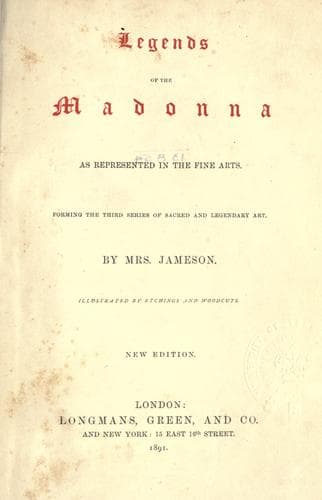
Legends of the Madonna as Represented in the Fine ArtsJameson, Mrs. (Anna)
Religion
Legends of the Madonna as Represented in the Fine Arts
Jameson, Mrs. (Anna)
Christian saints in art; Mary, Blessed Virgin, Saint -- Art; Mary, Blessed Virgin, Saint -- Legends
1. The Coronation of the Virgin is a strictly devotional subject where
she is attended, not merely by angels and patriarchs, but by canonized
saints and martyrs, by fathers and doctors of the Church, heads of
religious orders in monkish dresses, patrons and votaries.
2. It is a dramatic and historical subject when it is the last scene
in a series of the Life of the Virgin; when the death-bed, or the
tomb, or the wondering apostles, and weeping women, are figured on
the earth below.
Of the former treatment, I have spoken at length. It is that most
commonly met with in early pictures and altar-pieces.
With regard to the historical treatment, it is more rare as a separate
subject, but there are some celebrated examples both in church
decoration and in pictures.
1. In the apsis of the Duomo at Spoleto, we have, below, the death
of the Virgin in the usual manner, that is, the Byzantine conception
treated in the Italian style, with Christ receiving her soul, and over
it the Coronation. The Virgin kneels in a white robe, spangled with
golden flowers; and Christ, who is here represented rather as the
Father than the Son, crowns her as queen of heaven.
2. The composition by Albert Durer, which concludes his fine series
of wood-cuts, the "Life, of the Virgin" is very grand and singular. On
the earth is the empty tomb; near it the bier; around stand the twelve
apostles, all looking up amazed. There is no allusion to the girdle,
which, indeed, is seldom found in northern art. Above, the Virgin
floating in the air, with the rainbow under her feet, is crowned by
the Father and the Son, while over her head hovers the holy Dove.
3. In the Vatican is the Coronation attributed to Raphael. That he
designed the cartoon, and began the altar-piece, for the nuns of
Monte-Luce near Perugia, seems beyond all doubt; but it is equally
certain that the picture as we see it was painted almost entirely by
his pupils Giulo Romano and Gian Francesco Penni. Here we have the
tomb below, filled with flowers; and around it the twelve apostles;
John and his brother James, in front, looking up; behind John, St.
Peter; more in the background, St. Thomas holds the girdle. Above is
the throne set in heaven, whereon the Virgin, mild and beautiful, sits
beside her divine Son, and with joined hands, and veiled head, and
eyes meekly cast down, bends to receive the golden coronet he is about
to place on her brow. The Dove is omitted, but eight seraphim, with
rainbow-tinted wings, hover above her head. On the right, a most
graceful angel strikes the tambourine; on the left, another, equally
graceful, sounds the viol; and, amidst a flood of light, hosts of
celestial and rejoicing spirits fill up the background.
Thus, in highest heaven, yet not out of sight of earth, in beatitude
past utterance, in blessed fruition of all that faith creates and love
desires, amid angel hymns and starry glories, ends the pictured life
of Mary, MOTHER OF OUR LORD.
THE END.
Public-domain text, read in full here on John Shaqi.
Reviews
Reviews
No reviews yet
Be the first to share your thoughts on this work.
Elsewhere in the archive
Join the Discussion
Join the discussion
Sign in to leave a comment or review.
Sign InorCreate an account