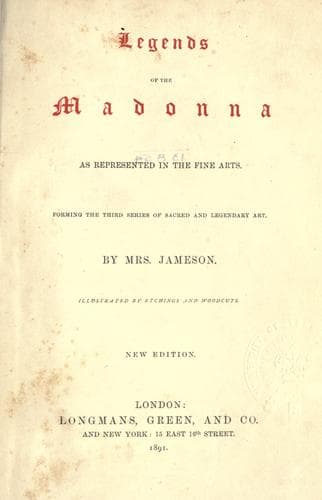
Legends of the Madonna as Represented in the Fine ArtsJameson, Mrs. (Anna)
Religion
Legends of the Madonna as Represented in the Fine Arts
Jameson, Mrs. (Anna)
Christian saints in art; Mary, Blessed Virgin, Saint -- Art; Mary, Blessed Virgin, Saint -- Legends
I shall begin with those symbols which are borrowed from the Litanies
of the Virgin, and from certain texts of the Canticles, in all ages
of the Church applied to her; symbols which, in the fifteenth and
sixteenth centuries, frequently accompany those representations
which set forth her Glorification or Predestination; and, in the
seventeenth, are introduced into the "Immaculate Conception."
1. The Sun and the Moon.--"Electa ut Sol, pulchra ut Luna," is one
of the texts of the Canticles applied to Mary; and also in a passage
of the Revelation, "_A woman clothed with the sun, having the moon
under her feet, and on her head a crown of twelve stars._" Hence the
radiance of the sun above her head, and the crescent moon beneath her
feet. From inevitable association the crescent moon suggests the
idea of her perpetual chastity; but in this sense it would be a pagan
rather than a Christian attribute.
2. The STAR.--This attribute, often embroidered in front of the veil
of the Virgin or on the right shoulder of her blue mantle, has become
almost as a badge from which several well-known pictures derive
their title, "La Madonna della Stella." It is in the first place
an attribute alluding to the most beautiful and expressive of her
many titles:--"_Stella Maris_" Star of the Sea,[1] which is one
interpretation of her Jewish name, _Miriam_: but she is also "_Stella
Jacobi_," the Star of Jacob; "_Stella Matutina_," the Morning Star;
"_Stella non Erratica_," the Fixed Star. When, instead of the single
star on her veil or mantle, she has the crown of twelve stars, the
allusion is to the text of the Apocalypse already quoted, and the
number of stars is in allusion to the number of the Apostles.[2]
[Footnote 1:
"Ave Maris Stella
Dei Mater alma!" &c.]
[Footnote 2: "In capite inquit ejus corona stellarum duodecim; quidni
coronent sidera quam sol vestit?"--_St. Bernard_.]
3. The LILY.--"_I am the rose of Sharon, and lily of the valleys._"
(Cant. ii. 1, 2.) As the general emblem of purity, the lily is
introduced into the Annunciation, where it ought to be without
stamens: and in the enthroned Madonnas it is frequently placed in
the hands of attendant angels, more particularly in the Florentine
Madonnas; the lily, as the emblem of their patroness, being chosen
by the citizens as the _device_ of the city. For the same reason it
became that of the French monarchy. Thorns are sometimes interlaced
with the lily, to express the "_Lilium inter Spinas_." (Cant. ii. 2.)
4. The ROSE.--She is the rose of Sharon, as well as the lily of the
valley; and as an emblem of love and beauty, the rose is especially
dedicated to her. The plantation or garden of roses[1] is often
introduced; sometimes it forms the background of the picture. There
is a most beautiful example in a Madonna by Cesare di Sesto (Milan,
Brera); and another, "the Madonna of the Rose Bush," by Martin Schoen.
(Cathedral, Colmar.)
[Footnote 1: Quasi plantatio rosæ in Jericho.]
Public-domain text, read in full here on John Shaqi.
Reviews
Reviews
No reviews yet
Be the first to share your thoughts on this work.
Join the Discussion
Join the discussion
Sign in to leave a comment or review.
Sign InorCreate an account