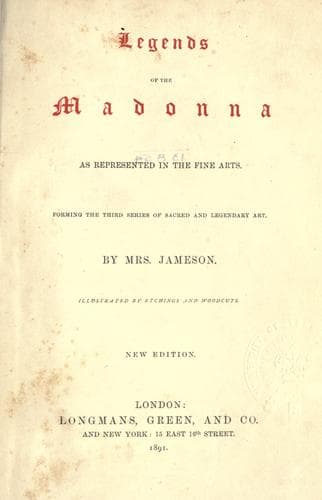
Legends of the Madonna as Represented in the Fine ArtsJameson, Mrs. (Anna)
Religion
Legends of the Madonna as Represented in the Fine Arts
Jameson, Mrs. (Anna)
Christian saints in art; Mary, Blessed Virgin, Saint -- Art; Mary, Blessed Virgin, Saint -- Legends
5. As spiritual conquerors in the name of the Virgin, St. Dominic and
St. Francis, each attended by two companions of his Order.
6. As military conquerors in the name of the Virgin, the Emperor
Heraclius, and Narses, the general against the Arians.
7. A group of three female figures, representing the three famous
saintly princesses who in marriage preserved their virginity,
Pulcheria, Edeltruda (our famous queen Ethelreda), and Cunegunda. (For
the legends of Cunegunda and Ethelreda, see Legends of the Monastic
Orders.)
8. A group of three learned Bishops, who had especially defended the
immaculate purity of the Virgin, St. Cyril, St. Anselm, and St. Denis
(?).
9. The miserable ends of those who were opposed to the honour of the
Virgin. 1. The death of Julian the Apostate, very oddly represented;
he lies on an altar, transfixed by an arrow, as a victim; St.
Mercurius in the air. (For this legend see Sacred and Legendary Art.)
2. The death of Leo IV., who destroyed the effigies of the Virgin. 3.
The death of Constantine IV., also a famous iconoclast.
The statues which are placed in niches are--
1, 2. St. Joseph, as the nominal husband, and St. John the Evangelist,
as the nominal son of the Virgin; the latter, also, as prophet and
poet, with reference to the passage in the Revelation, c. xii. 1.
3, 4. Aaron, as priestly ancestor (because his wand blossomed), and
David, as kingly ancestor of the Virgin.
5, 6. St. Dionysius the Areopagite, who was present at the death of
the Virgin, and St. Bernard, who composed the famous "Salve Regina" in
her honour.
Such is this grand systematic scheme of decoration, which, to those
who regard it cursorily, is merely a sumptuous confusion of colours
and forms, or at best, "a fine example of the Guido school and
Bernino." It is altogether a very complete and magnificent specimen
of the prevalent style of art, and a very comprehensive and suggestive
expression of the prevalent tendency of thought, in the Roman
Catholic Church from the beginning of the seventeenth century. In no
description of this chapel have I ever seen the names and subjects
accurately given: the style of art belongs to the _decadence_, and the
taste being worse than, questionable, the pervading _doctrinal_ idea
has been neglected, or never understood.
III.
Public-domain text, read in full here on John Shaqi.
Reviews
Reviews
No reviews yet
Be the first to share your thoughts on this work.
Elsewhere in the archive
Join the Discussion
Join the discussion
Sign in to leave a comment or review.
Sign InorCreate an account