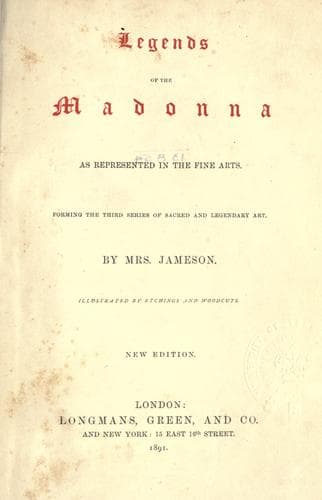
Legends of the Madonna as Represented in the Fine ArtsJameson, Mrs. (Anna)
Religion
Legends of the Madonna as Represented in the Fine Arts
Jameson, Mrs. (Anna)
Christian saints in art; Mary, Blessed Virgin, Saint -- Art; Mary, Blessed Virgin, Saint -- Legends
Those pictures which represent the Virgin Mary kneeling before the
celestial throne, while the PADRE ETERNO or the MESSIAH extends his
hand or his sceptre towards her, are generally misunderstood. They
do not represent, the Assumption, nor yet the reception of Mary in
Heaven, as is usually supposed; but the election or predestination of
Mary as the immaculate vehicle or tabernacle of human redemption--the
earthly parent of the divine Saviour. I have described such a picture
by Dosso Dossi, and another by Cottignola. A third example may be
cited in a yet more beautiful and celebrated picture by Francia, now
in the Church at San Frediano at Lucca. Above, in the glory of Heaven,
the Virgin kneels before the throne of the Creator; she is clad in
regal attire of purple and crimson and gold; and she bends her fair
crowned head, and folds her hands upon her bosom with an expression
of meek yet dignified resignation--"_Behold the handmaid of the
Lord!_"--accepting, as woman, that highest glory, as mother, that
extremest grief, to which the Divine will, as spoken by the prophets
of old, had called her. Below, on the earth and to the right hand,
stand David and Solomon, as prophets and kingly ancestors: on the left
hand, St. Augustine and St. Anselm in their episcopal robes. (I have
mentioned, with regard to the office in honour of the Immaculate
Conception, that the idea is said to have originated in England. I
should also have added, that Anselm, Archbishop of Canterbury, was
its strenuous advocate.) Each of these personages holds a scroll. On
that of David the reference is to the 4th and 5th verses of Psalm
xxvii.--"_In the secret of his tabernacle he shall hide me_." On
that of Solomon is the text from his Song, ch. iv. 7. On that of St.
Augustine, a quotation, I presume, from his works, but difficult
to make out; it seems to be, "_In coelo qualis est Pater, talis est
Films; qualis est Filius, talis est Mater_." On that of St. Anselm the
same inscription which is on the picture of Cottignola quoted before,
"_non puto vere esse_." &c., which is, I suppose, taken from his
works. In the centre, St. Anthony of Padua kneels beside the sepulchre
full of lilies and roses; showing the picture to have been painted
for, or under the influence of, the Franciscan Order; and, like other
pictures of the same class, "an attempt to express in a visible form
the idea or promise of the redemption of the human race, as existing
in the Sovereign Eternal Mind before the beginning of the world." This
altar-piece has no date, but appears to have been painted about the
same time as the picture in our National Gallery (No. 179.), which
came from the same church. As a work of art it is most wonderfully
beautiful. The editors of the last excellent edition of Vasari speak
of it with just enthusiasm as "_Opera veramente stupenda in ogni
parte_!" The predella beneath, painted in chiaro-oscuro, is also of
exquisite beauty; and let us hope that we shall never see it separated
Public-domain text, read in full here on John Shaqi.
Reviews
Reviews
No reviews yet
Be the first to share your thoughts on this work.
Elsewhere in the archive
Join the Discussion
Join the discussion
Sign in to leave a comment or review.
Sign InorCreate an account