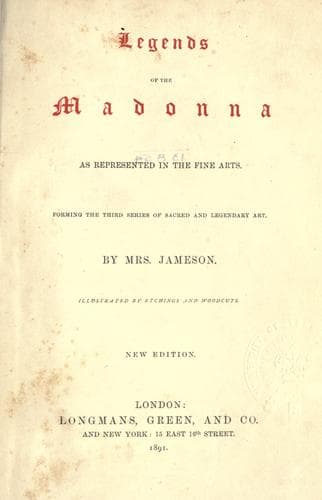
Legends of the Madonna as Represented in the Fine ArtsJameson, Mrs. (Anna)
Religion
Legends of the Madonna as Represented in the Fine Arts
Jameson, Mrs. (Anna)
Christian saints in art; Mary, Blessed Virgin, Saint -- Art; Mary, Blessed Virgin, Saint -- Legends
When the worship of the Virgin came to us from the East, with it came
the Greek type--and for ages we had no other--the Greek classical
type, with something of the Oriental or Egyptian character. When thus
she stands before us without her Son, and the apostles or saints on
each side taking the subordinate position, then we are to regard her
not only as the mother of Christ, but as the second Eve, the mother of
all suffering humanity; THE WOMAN of the primeval prophecy whose issue
was to bruise the head of the Serpent; the Virgin predestined from
the beginning of the world who was to bring forth the Redeemer of the
world; the mystical Spouse of the Canticles; the glorified Bride of
a celestial Bridegroom; the received Type of the Church of Christ,
afflicted on earth, triumphant and crowned in heaven; the most
glorious, most pure, most pious, most clement, most sacred Queen and
Mother, Virgin of Virgins.
The form under which we find this grand and mysterious idea of
glorified womanhood originally embodied, is wonderfully majestic
and simple. A female figure of colossal dimensions, far exceeding
in proportion all the attendant personages and accessories, stands
immediately beneath some figure or emblem representing almighty power:
either it is the omnipotent hand stretched out above her, holding the
crown of immortality; or it is the mystic dove which hovers over her;
or it is the half-form of Christ, in the act of benediction.
She stands with arms raised and extended wide, the ancient attitude of
prayer; or with hands merely stretched forth, expressing admiration,
humility, and devout love. She is attired in an ample tunic of
blue or white, with a white veil over her head, thrown a little
back, and displaying an oval face with regular features, mild,
dignified--sometimes, in the figures of the ruder ages, rather stern
and melancholy, from the inability of the artist to express beauty;
but when least beautiful, and most formal and motionless, always
retaining something of the original conception, and often expressibly
striking and majestic.
Public-domain text, read in full here on John Shaqi.
Reviews
Reviews
No reviews yet
Be the first to share your thoughts on this work.
Elsewhere in the archive
Join the Discussion
Join the discussion
Sign in to leave a comment or review.
Sign InorCreate an account