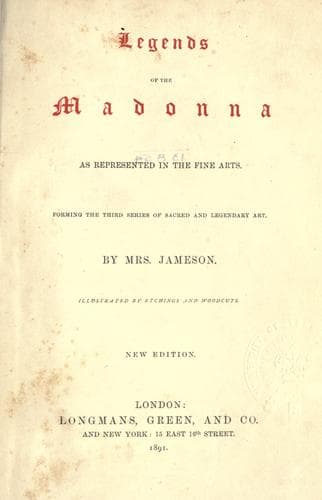
Legends of the Madonna as Represented in the Fine ArtsJameson, Mrs. (Anna)
Religion
Legends of the Madonna as Represented in the Fine Arts
Jameson, Mrs. (Anna)
Christian saints in art; Mary, Blessed Virgin, Saint -- Art; Mary, Blessed Virgin, Saint -- Legends
from the great subject, like a page or a paragraph torn out of a book
by ignorant and childish collectors.
IV.
Although the Nativity of the Virgin Mary is one of the great festivals
of the Roman Catholic Church, I have seldom seen it treated as
a separate subject and an altar-piece. There is, however, a very
remarkable example in the Belle Arti at Siena. It is a triptych
enclosed in a framework elaborately carved and gilt, in the
Gothic style. In the centre compartment, St. Anna lies on a rich
couch covered with crimson drapery; a graceful female presents an
embroidered napkin, others enter, bringing refreshments, as usual.
In front, three attendants minister to the Infant: one of them is in
an attitude of admiration; on the right, Joachim seated, with white
hair and beard, receives the congratulations of a young man who seems
to envy his paternity. In the compartment on the right stand St.
James Major and St. Catherine; on the left, St. Bartholomew and St.
Elizabeth of Hungary (?). This picture is in the hard primitive style
of the fourteenth century, by an unknown painter, who must have lived,
before Giovanni di Paolo, but vividly coloured, exquisitely finished,
and full of sentiment and dramatic feeling.
DEVOTIONAL SUBJECTS.
PART I.
THE VIRGIN WITHOUT THE CHILD.
1. LA VERGINE GLORIOSA. 2. L'INCORONATA.
3. LA MADONNA DI MISERICORDIA. 4. LA MADRE
DOLOROSA. 5. LA CONCEZIONE.
THE VIRGIN MARY.
_Lat._ 1. Virgo Gloriosa. 2. Virgo Sponsa Dei. 3. Virgo Potens 4.
Virgo Veneranda. 5. Virgo Prædicanda. 6. Virgo Clemens. 7. Virgo
Sapientissima. 8. Sancta Virgo Virginum. _Ital._ La Vergine Gloriosa.
La Gran Vergine delle Vergini. _Fr._ La Grande Vierge.
There are representations of the Virgin, and among them some of the
earliest in existence, which place her before us as an object of
religious veneration, but in which the predominant idea is not that
of her maternity. No doubt it was as the mother of the Saviour Christ
that she was originally venerated; but in the most ancient monuments
of the Christian faith, the sarcophagi, the rude paintings in the
catacombs, and the mosaics executed before the seventh century,
she appears simply as a veiled female figure, not in any respect
characterized. She stands, in a subordinate position, on one side of
Christ; St. Peter or St. John the Baptist on the other.
Public-domain text, read in full here on John Shaqi.
Reviews
Reviews
No reviews yet
Be the first to share your thoughts on this work.
Elsewhere in the archive
Join the Discussion
Join the discussion
Sign in to leave a comment or review.
Sign InorCreate an account