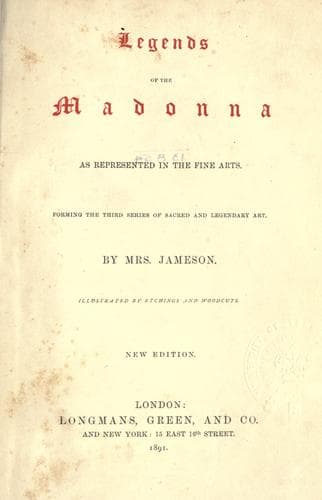
Legends of the Madonna as Represented in the Fine ArtsJameson, Mrs. (Anna)
Religion
Legends of the Madonna as Represented in the Fine Arts
Jameson, Mrs. (Anna)
Christian saints in art; Mary, Blessed Virgin, Saint -- Art; Mary, Blessed Virgin, Saint -- Legends
To the Roman Catholics this idea remains an indisputable religious
truth of the highest import. Those of a different creed may think fit
to dispose of the whole subject of the Madonna either as a form of
superstition or a form of Art. But merely as a form of Art, we cannot
in these days confine ourselves to empty conventional criticism. We
are obliged to look further and deeper; and in this department of
Legendary Art, as in the others, we must take the higher ground,
perilous though it be. We must seek to comprehend the dominant idea
lying behind and beyond the mere representation. For, after all,
some consideration is due to facts which we must necessarily accept,
whether we deal with antiquarian theology or artistic criticism;
namely, that the worship of the Madonna did prevail through all the
Christian and civilized world for nearly a thousand years; that, in
spite of errors, exaggerations, abuses, this worship did comprehend
certain great elemental truths interwoven with our human nature, and
to be evolved perhaps with our future destinies. Therefore did it work
itself into the life and soul of man; therefore has it been worked
_out_ in the manifestations of his genius; and therefore the multiform
imagery in which it has been clothed, from the rudest imitations of
life, to the most exquisite creations of mind, may be resolved, as a
whole, into one subject, and become one great monument in the history
of progressive thought and faith, as well as in the history of
progressive art.
Of the pictures in our galleries, public or private,--of the
architectural adornments of those majestic edifices which sprung up
in the middle ages (where they have not been despoiled or desecrated
by a zeal as fervent as that which reared them), the largest and most
beautiful portion have reference to the Madonna,--her character,
her person, her history. It was a theme which never tired her
votaries,--whether, as in the hands of great and sincere artists,
it became one of the noblest and loveliest, or, as in the hands
of superficial, unbelieving, time-serving artists, one of the most
degraded. All that human genius, inspired by faith, could achieve of
best, all that fanaticism, sensualism, atheism, could perpetrate of
worst, do we find in the cycle of those representations which have
been dedicated to the glory of the Virgin. And indeed the ethics of
the Madonna worship, as evolved in art, might be not unaptly likened
to the ethics of human love: so long as the object of sense remained
in subjection to the moral idea--so long as the appeal was to the
best of our faculties and affections--so long was the image grand or
refined, and the influences to be ranked with those which have helped
to humanize and civilize our race; but so soon as the object became
a mere idol, then worship and worshippers, art and artists, were
together degraded.
Public-domain text, read in full here on John Shaqi.
Reviews
Reviews
No reviews yet
Be the first to share your thoughts on this work.
Join the Discussion
Join the discussion
Sign in to leave a comment or review.
Sign InorCreate an account