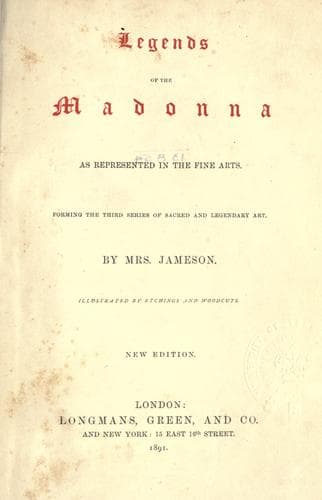
Legends of the Madonna as Represented in the Fine ArtsJameson, Mrs. (Anna)
Religion
Legends of the Madonna as Represented in the Fine Arts
Jameson, Mrs. (Anna)
Christian saints in art; Mary, Blessed Virgin, Saint -- Art; Mary, Blessed Virgin, Saint -- Legends
From the time that the heresy of Nestorius had been condemned, and
that the dignity of the Virgin as mother of the _Divinity_ had become
a point of doctrine, it was not enough to advocate her excelling
virtue and stainless purity as a mere human being. It was contended,
that having been predestined from the beginning as the Woman, through
whom the divine nature was made manifest on earth, she must be
presumed to be exempt from all sin, even from that original taint
inherited from Adam. Through the first Eve, we had all died; through
the second Eve, we had all been "made alive." It was argued that
God had never suffered his earthly temple to be profaned; had even
promulgated in person severe ordinances to preserve its sanctuary
inviolate. How much more to him was that temple, that _tabernacle_
built by no human hands, in which he had condescended to dwell.
Nothing was impossible to God; it lay, therefore, in his power to
cause his Mother to come absolutely pure and immaculate into the
world: being in his power, could any earnest worshipper of the Virgin
doubt for a moment that for one so favoured it would not be done? Such
was the reasoning of our forefathers; and the premises granted, who
shall call it illogical or irreverent?
For three or four centuries, from the seventh to the eleventh, these
ideas had been gaining ground. St. Ildefonso of Seville distinguished
himself by his writings on this subject; and how the Virgin
recompensed his zeal, Murillo has shown us, and I have related in
the life of that saint. (Legends of the Monastic Orders.) But the
first mention of a festival, or solemn celebration of the Mystery of
the Immaculate Conception, may be traced to an English monk of the
eleventh century, whose name is not recorded, (v. Baillet, vol. xii.)
When, however, it was proposed to give the papal sanction to this
doctrine as an article of belief, and to institute a church office for
the purpose of celebrating the Conception of Mary, there arose strong
opposition. What is singular, St. Bernard, so celebrated for his
enthusiastic devotion to the Virgin, was most strenuous and eloquent
in his disapprobation. He pronounced no judgment against those who
received the doctrine of the Immaculate Conception, he rather leaned
towards it; but he opposed the institution of the festival as an
innovation not countenanced by the early fathers of the Church. After
the death of St. Bernard, for about a hundred years, the dispute
slept; but the doctrine gained ground. The thirteenth century, so
remarkable for the manifestation of religious enthusiasm in all its
forms, beheld the revival of this celebrated controversy. A certain
Franciscan friar, Duns Scotus (John Scott of Dunse), entered the lists
as champion for the Virgin. He was opposed by the Dominicans and their
celebrated polemic Thomas Aquinas, who, like St. Bernard, was known
for his enthusiastic reverence for the Virgin; but, like him, and on
Public-domain text, read in full here on John Shaqi.
Reviews
Reviews
No reviews yet
Be the first to share your thoughts on this work.
Elsewhere in the archive
Join the Discussion
Join the discussion
Sign in to leave a comment or review.
Sign InorCreate an account