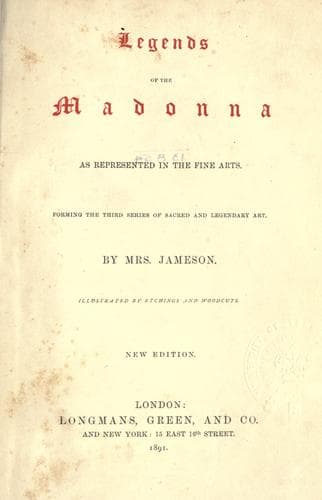
Legends of the Madonna as Represented in the Fine ArtsJameson, Mrs. (Anna)
Religion
Legends of the Madonna as Represented in the Fine Arts
Jameson, Mrs. (Anna)
Christian saints in art; Mary, Blessed Virgin, Saint -- Art; Mary, Blessed Virgin, Saint -- Legends
the same grounds, objected to the introduction of new forms. Thus the
theological schools were divided.
During the next two hundred years the belief became more and more
general, the doctrine more and more popular; still the Church, while
it tolerated both, refused to ratify either. All this time we find
no particular representation of the favourite dogma in art, for until
ratified by the authority of the Church, it could not properly enter
into ecclesiastical decoration. We find, however, that the growing
belief in the pure Conception and miraculous sanctification of
the Virgin multiplied the representations of her coronation and
glorification, as the only permitted expression of the popular
enthusiasm on this point. For the powerful Order of the Franciscans,
who were at this time and for a century afterwards the most ardent
champions of the Immaculate Conception, were painted most of the
pictures of the Coronation produced during the fourteenth century.
The first papal decree touching the "Immaculate Conception" as an
article of faith, was promulgated in the reign of Sixtus IV., who
had been a Franciscan friar, and he took the earliest opportunity of
giving the solemn sanction of the Church to what had ever been the
favourite dogma of his Order; but the celebration of the festival,
never actually forbidden, had by this time become so usual, that
the papal ordinance merely sanctioned without however rendering it
obligatory. An office was composed for the festival, and in 1496
the Sorbonne declared in favour of it Still it remained a point of
dispute; still there were dissentient voices, principally among the
Dominican theologians; and from 1500 to 1600 we find this controversy
occupying the pens of the ecclesiastics, and exciting the interest and
the imagination of the people. In Spain the "Immaculate Conception
of the Virgin," owing perhaps to the popularity and power of the
Franciscans in that country, had long been "the darling dogma of the
Spanish Church." Villegas, in the "Flos Sanctorum," while admitting
the modern origin of the opinion, and the silence of the Church,
contended that, had this great fact been made manifest earlier and
in less enlightened times, it might possibly have led to the error of
worshipping the Virgin as an actual goddess. (Stirling's Artists of
Spain, p. 905.) To those who are conversant with Spanish theology
and art, it may seem that the distinction drawn in theory is not very
definite or perceptible in practice.
Public-domain text, read in full here on John Shaqi.
Reviews
Reviews
No reviews yet
Be the first to share your thoughts on this work.
Elsewhere in the archive
Join the Discussion
Join the discussion
Sign in to leave a comment or review.
Sign InorCreate an account